

BYD Skids into 2026 – EV Giant Sales Slide

BYD sales slump

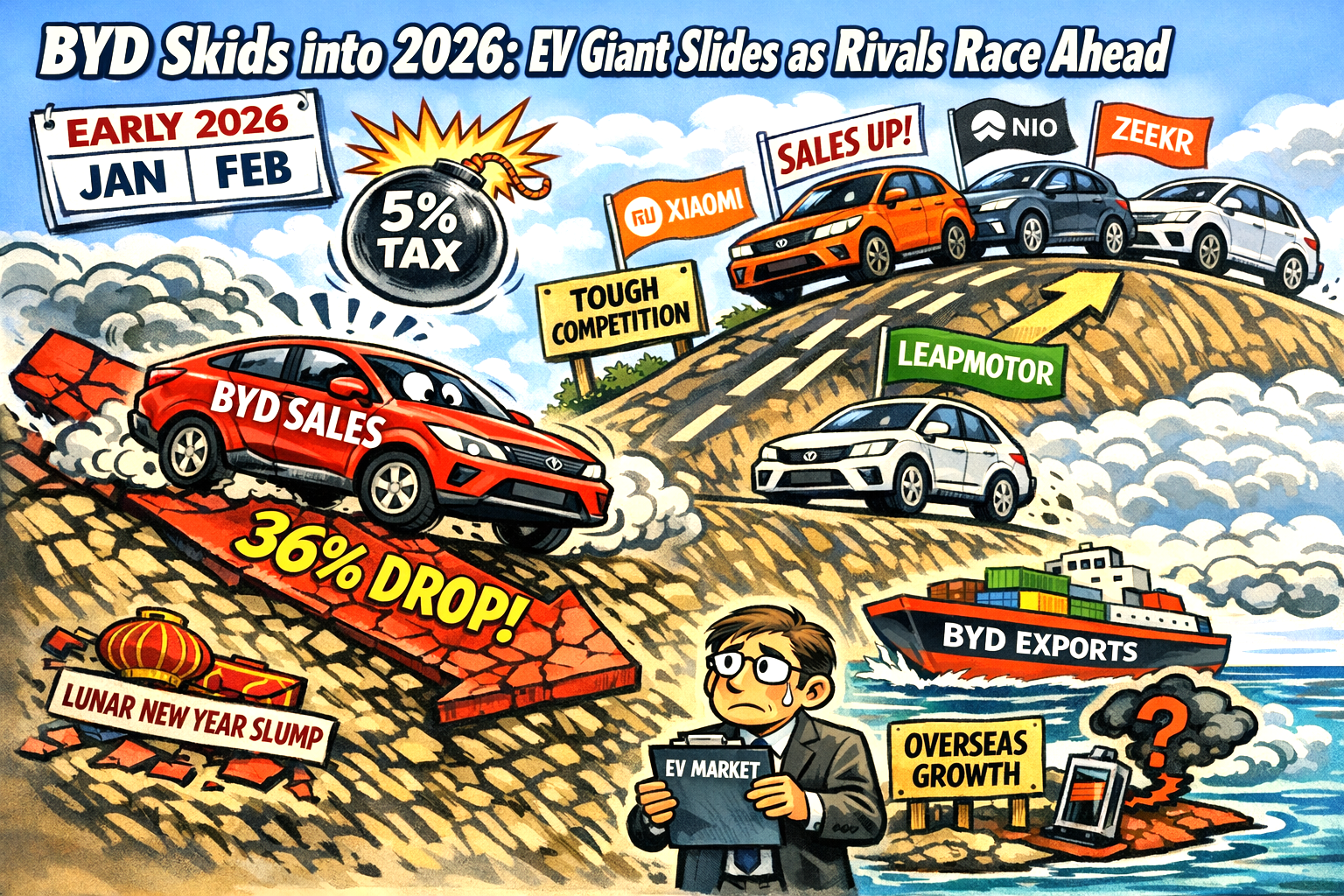
BYD’s sharp fall in electric‑vehicle sales across January and February 2026 marks a significant moment for the world’s largest EV maker, signalling both cyclical pressures and a deeper shift in China’s hyper‑competitive market.

Adjusted for the disruption caused by the mid‑February Lunar New Year holiday, BYD’s combined sales for the first two months of the year were down roughly 36% year on year, a rare contraction for a company that has spent the past three years dominating China’s new‑energy vehicle segment.

Slump

Several forces converged to produce the slump. The reinstatement of a 5% purchase tax on new‑energy vehicles at the end of 2025 pulled demand forward, leaving a vacuum in early 2026 as buyers rushed to complete purchases before the levy returned.

At the same time, China’s EV market is maturing, with consumers becoming more discerning and competitors far more aggressive.

Xiaomi, Leapmotor, Nio and Geely’s Zeekr all posted strong double‑digit growth over the same period, with Xiaomi’s YU7 SUV even becoming China’s best‑selling passenger vehicle in January.

This intensifying competition reflects a broader levelling of the playing field. Rivals are increasingly attacking BYD’s core mid‑market territory by packing more features into vehicles while keeping prices tight — a trend known locally as involution.

Leading still

Analysts note that while BYD’s lead remains substantial, it is narrowing as alternatives become more compelling.

Yet the picture is not uniformly negative. BYD’s strategic pivot towards overseas markets is beginning to pay off: in February 2026, its exports surpassed domestic sales for the first time, underscoring the company’s growing global footprint and providing a buffer against domestic volatility.

Later in 2026, BYD is expected to launch new models featuring its next‑generation Blade Battery 2.0 and faster flash‑charging technology — innovations that could help reignite domestic demand without resorting to a price war.
Tesla earnings disappoint and Chinese EV stocks fall

Tesla

Shares of Chinese electric vehicle manufacturers took a hit on Thursday 18th October 2023 after Tesla reported disappointing 3Q results on Wednesday 17th October 2023.

It was the first time Tesla, co-founded by Elon Musk, missed on both earnings and revenue since Q2 2019.

On Thursday morning, Hong Kong-listed shares of Chinese EV makers BYD and Xpeng fell approximately 2.18% and 8.76%. Li Auto slid 3.14%, while Nio and Geely dropped 8.36% and 3.97%.

Elon Musk reportedly cautioned that the Tesla Cybertruck, the electric full-size pickup truck model; would not deliver substantial positive cashflow for 12-18 months after production begins.

Musk reportedly said the company is working to bring down the prices of its cars amid high interest rates. ‘I’m worried about the high interest rate environment we’re in,’ he said, adding that it will be much harder for consumers to purchase cars if interest rates were to increase further.

Tesla shares down

Tesla shares closed 4.78% lower on Wednesday 17th October 2023. Other U.S. EV rivals Lucid and Rivian fell more than 9% on the same day. Lucid’s stock dropped a day earlier after it reported disappointing Q3 EV deliveries.

Tesla shares closed 4.78% lower on Wednesday 17th October 2023.

In the first six months of the year, BYD was the world’s top EV manufacturer, contributing 21% of global sales of EVs, according to research firm Canalys. Tesla trailed behind at second place with 15% market share while German carmaker Volkswagen held 7% market share in third place.

Price pressure

EV players are under pressure from a price war to gain market share amid intense competition.

Tesla introduced a number of price cuts over the last few months, especially in China – the world’s biggest EV market.

Rivals BYD, Nio, Li Auto and Xpeng have also joined Tesla in lowering the prices for some of their EV models.

Shares in BYD, (Build Your Dreams), jumped this week after it said it expected third-quarter profits to more than double compared with last year.

BYD is now ahead of Tesla in quarterly production – and second to the U.S. car maker in global sales.