

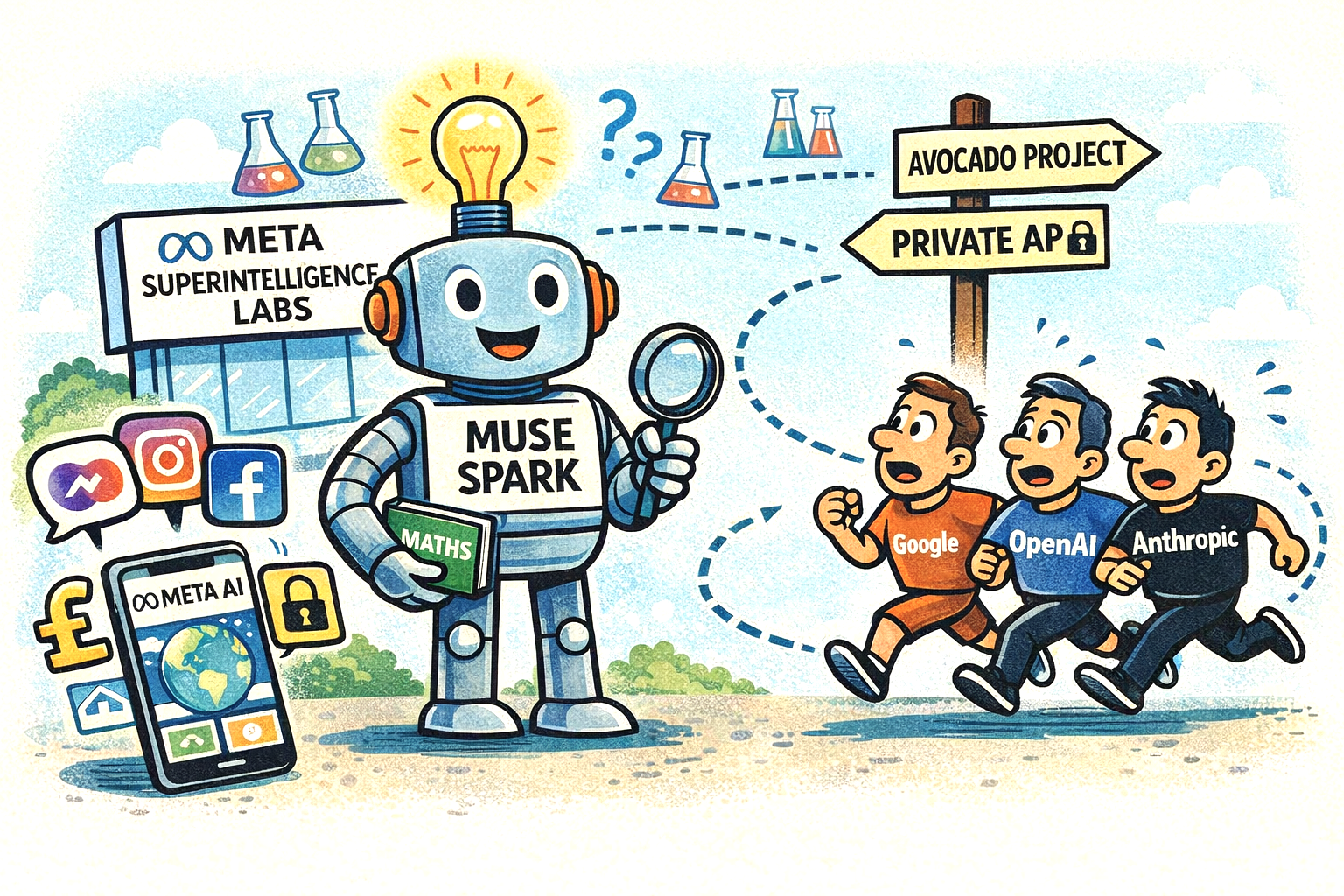
Meta has unveiled Muse Spark, its first major artificial intelligence model since the company overhauled its AI strategy in response to the underwhelming reception of its previous Llama 4 models.
Developed by the newly formed Meta Superintelligence Labs under the leadership of Alexandr Wang, Muse Spark represents a deliberate shift towards smaller, faster, and more capable systems designed to compete directly with Google, OpenAI, and Anthropic.
Foundation
Muse Spark is positioned as the foundation of a new family of models internally known as Avocado. Meta reportedly describes it as “small and fast by design”, yet able to reason through complex questions in science, maths, and health — a notable claim given the company’s recent struggles to keep pace with rivals.
Early evaluations suggest the model performs competitively in language and visual understanding, though it still trails in coding and abstract reasoning.
Crucially, Muse Spark is deeply integrated into Meta’s ecosystem. It already powers the Meta AI app and website and will soon replace Llama across WhatsApp, Instagram, Facebook, Messenger, and Meta’s smart glasses.
Integrated
This rollout signals Meta’s intention to embed AI more tightly into everyday user interactions, from search and recommendations to multimodal tasks such as analysing photos or comparing products.
The company is also experimenting with new revenue streams by offering a private API preview to select partners — a departure from its previous open‑source approach.
Whether this shift will alienate developers who embraced the openness of Llama remains to be seen.
Meta frames Muse Spark as an early step toward “personal superintelligence”, an assistant that can understand the world alongside the user rather than waiting for typed instructions.
It’s an ambitious vision — and one that will be tested as the model expands globally and faces scrutiny over privacy, safety, and real‑world performance.