

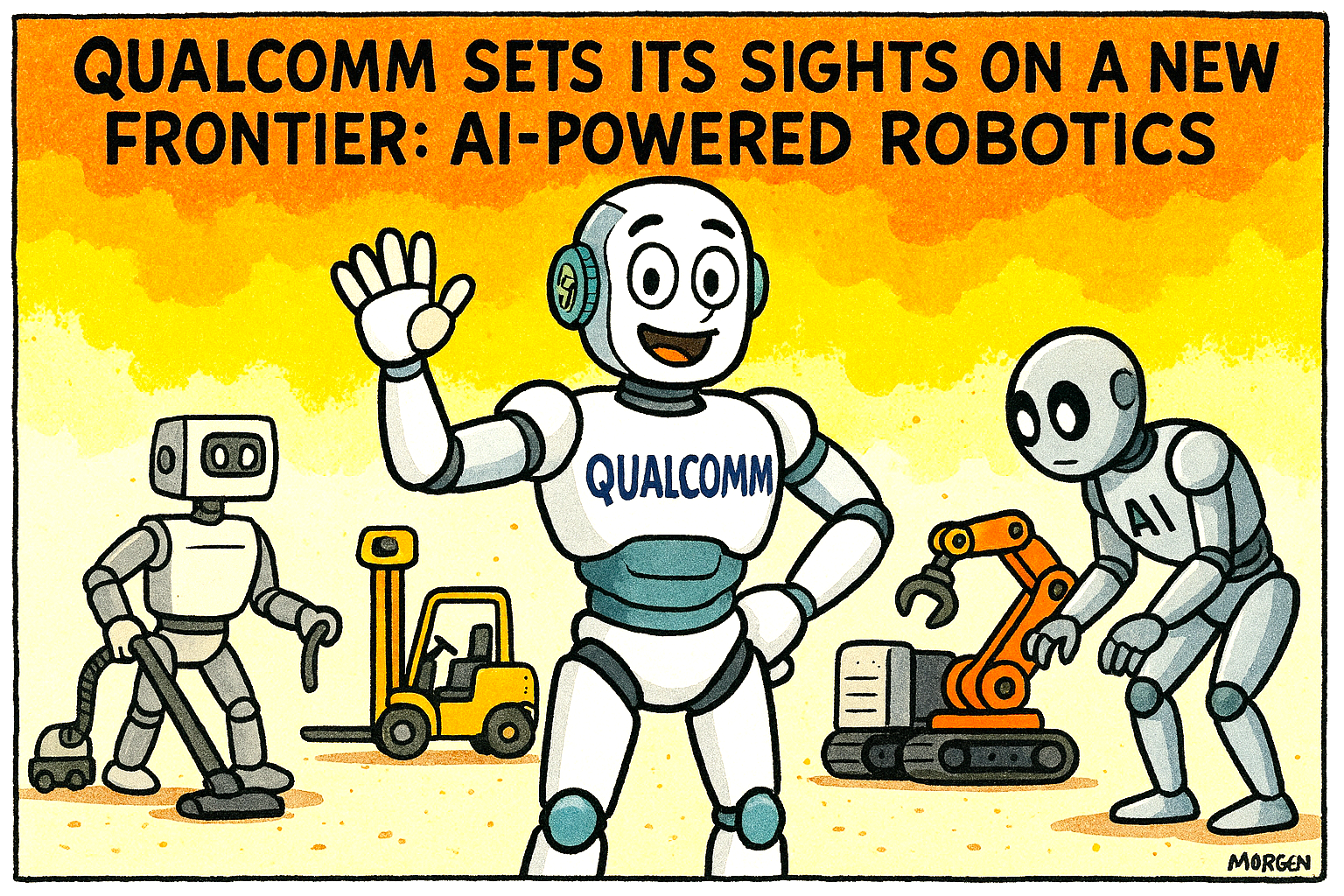
Qualcomm Sets Its Sights on a New Frontier: AI‑Powered Robotics

Qualcomm's Robotic Ambition

Qualcomm is accelerating its push into artificial intelligence and robotics, signalling a strategic shift that could redefine the company’s future beyond smartphones.

Executives now describe robotics as a core growth pillar, with chief executive Cristiano Amon reportedly forecasting that intelligent machines will become a “larger opportunity” for the business within the next two years.

Expanding from Mobile Chips to Physical AI

For decades, Qualcomm’s dominance has rested on its mobile processors, which power much of the global smartphone market.

The company is now repurposing that expertise for what it calls physical AIrobots capable of perceiving, reasoning, and acting autonomously in real‑world environments.

This transition reflects a broader industry trend: as generative AI matures, attention is shifting from digital assistants to embodied systems that can perform physical tasks.

Qualcomm’s new robotics architecture, unveiled recently, is designed as a full‑stack platform. It combines high‑efficiency system‑on‑chips, safety‑certified compute modules, and advanced on‑device AI models.

The aim is to give robot manufacturers a scalable foundation, whether they are building compact consumer devices or full‑size humanoids for industrial use.

Dragonwing Becomes the Flagship

At the centre of this strategy is the Dragonwing line of processors. The latest model, the Dragonwing IQ10, targets industrial automation and advanced humanoid robots.

It has reportedly been engineered to run complex AI models locally, reducing reliance on cloud connectivity and improving safety, responsiveness, and energy efficiency.
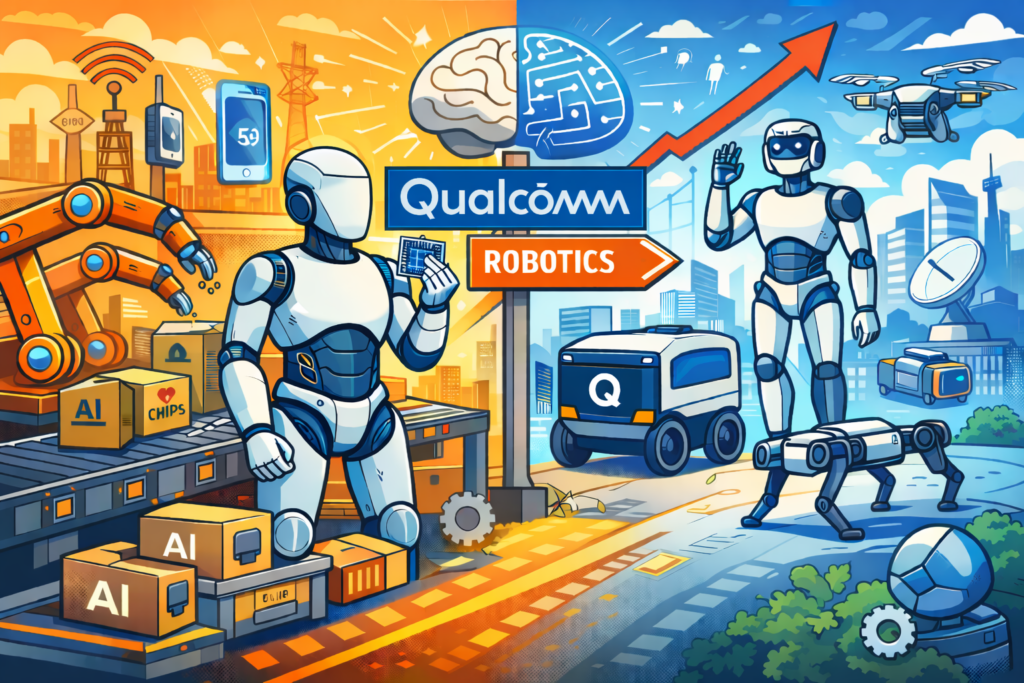
Qualcomm showcased these capabilities at recent industry events, where robots powered by Dragonwing chips demonstrated dexterity, mobility, and real‑time decision‑making.

The company’s ambition places it in direct competition with Nvidia, which currently dominates AI compute for robotics, and with a growing cohort of start‑ups building specialised hardware for autonomous machines.

Why Robotics Matters Now

Three factors underpin Qualcomm’s renewed focus

  • Diversifying revenue as smartphone markets plateau and competition intensifies.
  • Leveraging its edge‑AI strengths, particularly in low‑power, high‑performance chips suited to mobile robots.
  • Rising industrial demand, with logistics, retail, and manufacturing sectors adopting automation at scale.

The robotics push also complements Qualcomm’s automotive and PC AI strategies, creating a broader ecosystem of connected, intelligent devices.

A Critical Two Years Ahead

Qualcomm’s challenge now is to convert impressive demonstrations into commercial deployments.

If successful, the company could become a foundational supplier for the emerging era of physical AI—an era in which robots move from novelty to necessity.
Tesla’s $1 Trillion Bet on Elon Musk

$1 trillion Elon pay deal

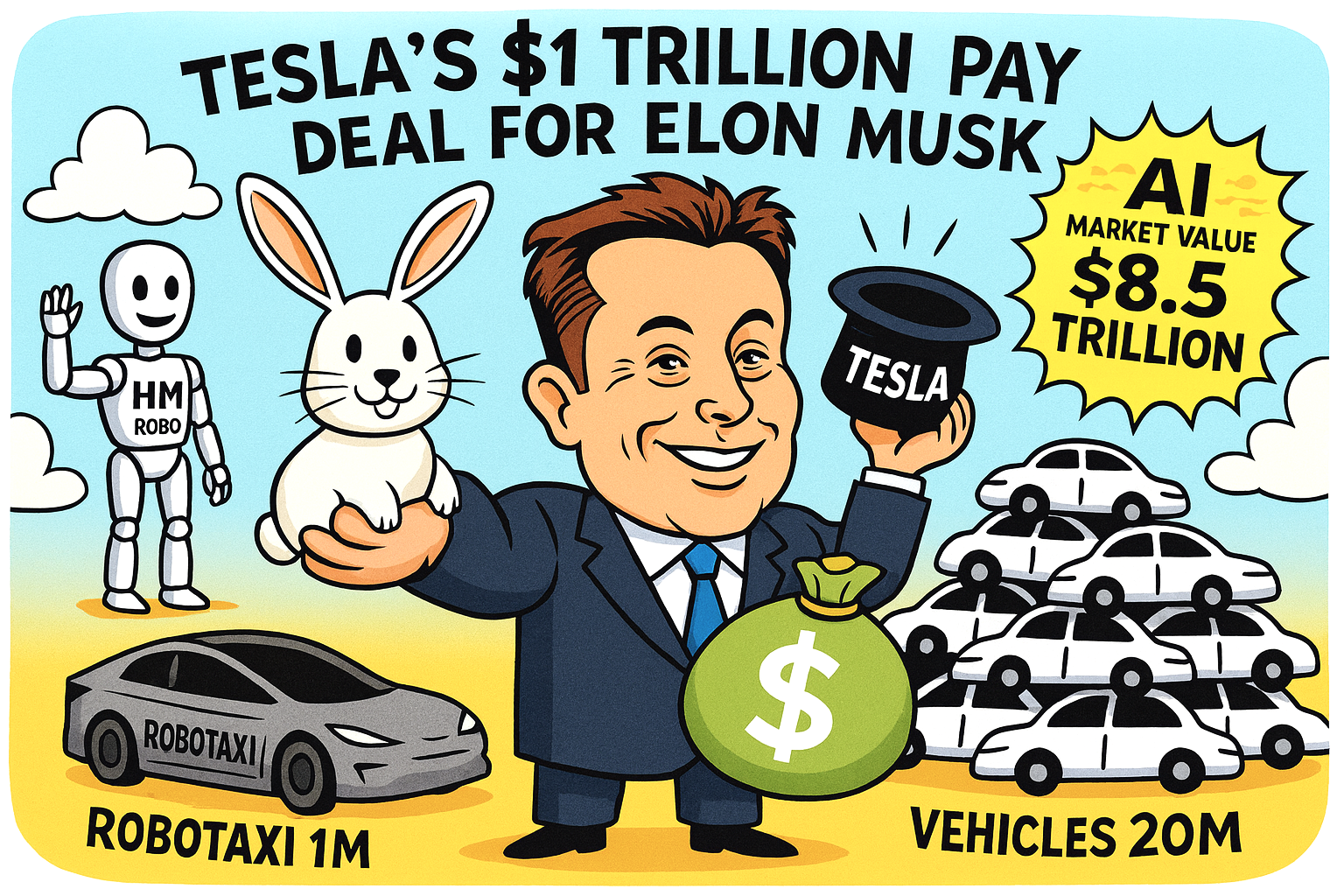
In a move that has stunned financial analysts, corporate governance experts, and the broader public alike, Tesla Inc. has approved a record-breaking $1 trillion (£761 billion) compensation package for its CEO, Elon Musk.

In a landmark decision, Tesla shareholders have approved a staggering $1 trillion (£761 billion) compensation package for CEO Elon Musk, marking the largest executive pay deal in corporate history.

The vote, held at Tesla’s annual meeting in Austin, Texas, reportedly saw over 75% of investors back the plan, reaffirming their confidence in Musk’s leadership and long-term vision.

Share deal

The deal is entirely performance-based, with Musk eligible to receive up to 423 million Tesla shares if the company meets a series of ambitious milestones.

These include producing 20 million vehicles annually, deploying one million robotaxis and humanoid robots, and reaching a market valuation of $8.5 trillion.

Reportedly there is no salary or cash bonus—Musk’s payout depends solely on Tesla’s success.

Supporters argue the package aligns Musk’s incentives with shareholder interests, encouraging innovation and growth.

Critics, however, warn of governance risks and the unprecedented concentration of wealth and power.

Musk, already the world’s richest person, could become the first trillionaire if Tesla achieves its targets.

The vote signals Tesla’s intent to evolve beyond electric vehicles into a broader tech powerhouse, betting on AI, robotics, and autonomy—with Musk at the helm.

OpenAI closes largest private tech deal on record

Tech deal

OpenAI on Monday 31st March 2025 announced it had closed its $40 billion funding round, the most ever raised by a private tech company.

The deal values OpenAI at $300 billion, including the new capital.

The round includes $30 billion from SoftBank and $10 billion from a syndicate of investors.

OpenAI is now more valuable than Chevron.

The generative AI market is projected to exceed $1 trillion in revenue within the next decade. Companies such as Google, Amazon, Anthropic, and Perplexity are rapidly unveiling new products and features as competition to develop ‘AI agents’ intensifies.

The future is AI!

Elon Musk suggests Tesla will use humanoid robots in 2025

A humanoid robot image

Tesla boss Elon Musk says the electric car maker will start producing and using humanoid robots from next year.

In a social media update, Elon Musk stated that Tesla will initially employ the robots, with plans to commence production for sale by 2026.

He had earlier anticipated that the robot, named Optimus, would be operational in Tesla factories by this year’s end. Additionally, companies such as Honda Rototics and Boston Dynamics are also advancing their humanoid robot technologies.

“Tesla will have genuinely useful humanoid robots in low production for Tesla internal use next year and, hopefully, high production for other companies in 2026,” Mr Musk posted on his social media platform X.

What is Grok?

Robot learning

Definition

Grok is a neologism (a newly coined word or expression), referenced by Robert A. Heinlein for his 1961 science fiction novel Stranger in a Strange Land. It means to understand something so deeply that you become one with it.

Grok is a term used in computer programming to mean to ‘profoundly understand something‘, such as a system, a language, or an algorithm.

Elon Musk’s Grok

Elon Musk debuts ‘Grok’ AI bot to rival ChatGPT and others. But, ‘Grok’ isn’t quite ready yet for the general public – it still has some learning to do. xAI, Elon Musk’s new AI venture, launched its first AI chatbot technology named ‘Grok’.

The prototype is in its infancy and early stages of training and is only available to a select group of users before a wider release.

Elon Musk debuts ‘Grok’ AI bot to rival ChatGPT and others. But, ‘Grok’ isn’t quite ready yet for the general public – it still has some learning to do

Musk is positioning xAI to compete with OpenAI, Inflection, Anthropic and others.

Less woke

Grok, the company said, is modelled on ‘The Hitchhiker’s Guide to the Galaxy’. It is supposed to have ‘a bit of wit, a rebellious streak’ and it should answer the ‘spicy questions’ that other AI might dodge, according to a statement from xAI.

Grok, the company said, is modelled on ‘The Hitchhiker’s Guide to the Galaxy’.

The company’s published mandate is to build artificial intelligence ‘to advance our collective understanding of the universe’. Musk has previously said that he believes today’s AI makers are bending too far toward ‘politically correct’ systems.

xAI’s mission, it reportedly said, ‘is to create AI for people of all backgrounds and political views’.

Future AI

Self-driving car technology, an AI Chatbot built around humour with access to current public data through X, a robot called Optimus and Musk’s drive for the ‘different’. If you add all this together, X.ai, through Musk, is likely positioning itself for the next big push in AI…

A humanoid robot for the workplace and for the home! Get ready… it’s coming!