
THE WIDER FALLOUT: How a Prolonged U.S.–Iran War Radiates Through the Global Economy

War in Iran Global Fallout Effects

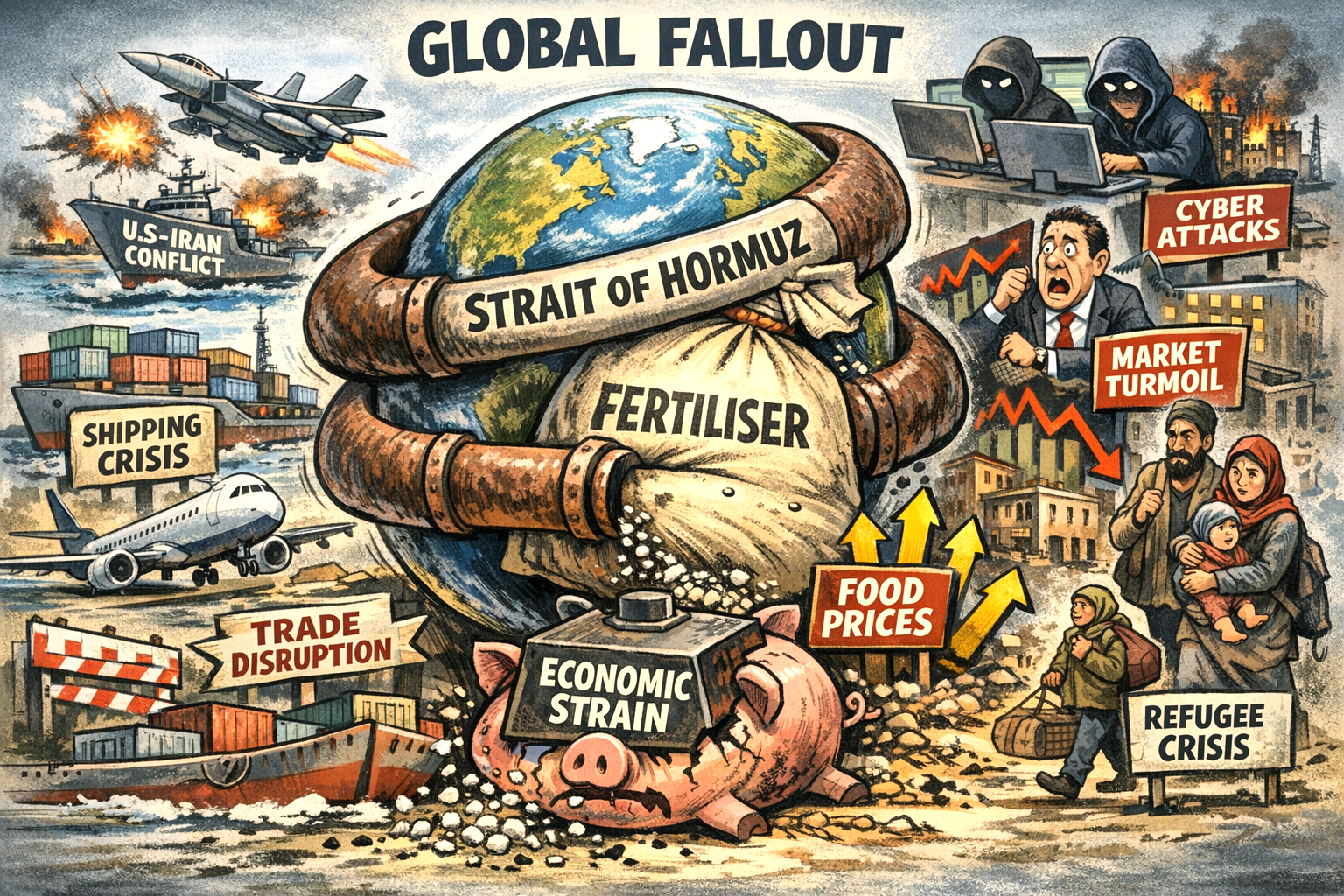
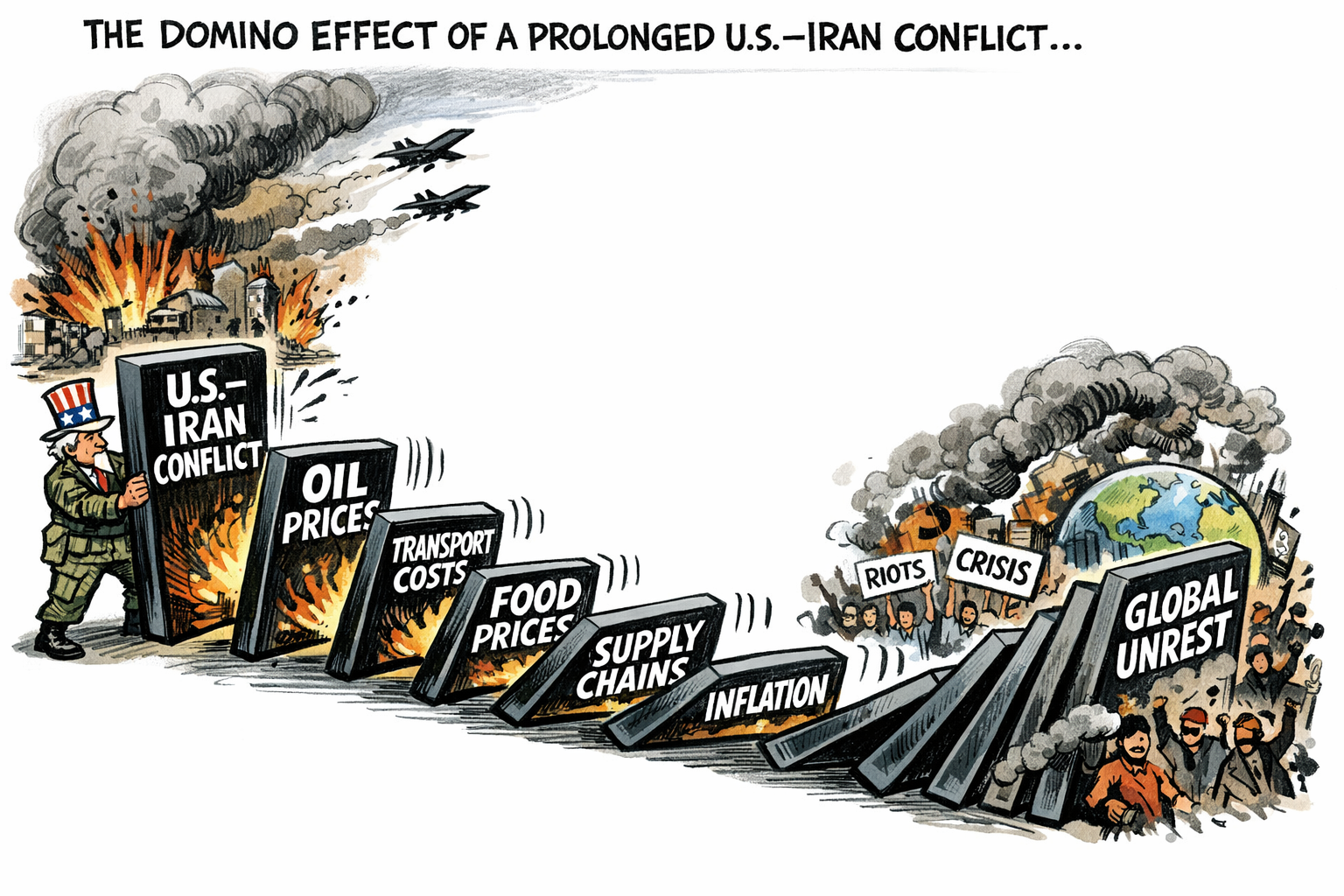
If the U.S.–Iran conflict drags on for weeks or months, the global impact will extend far beyond oil markets. Energy prices are only the first domino.

The deeper, more destabilising effects emerge through shipping disruption, fertiliser shortages, food‑price inflation, financial volatility, cyber escalation, and regional political instability.

For the UK — already wrestling with structural food‑system fragility — the conflict becomes a real‑world stress test.

This report outlines 15 potential major knock‑on effects that would shape the global economy if the conflict becomes protracted.

1. Global Shipping Disruption

The Strait of Hormuz is not just an oil artery; it is a global shipping chokepoint. As vessels reroute or halt operations:

  • Container shipping delays spread across Asia, Europe and the Gulf.
  • War‑risk insurance premiums spike for all vessels.
  • Freight costs rise, feeding into non‑energy inflation.

This is the mechanism by which a regional conflict becomes a global economic event.

2. Aviation and Travel Disruption

Iranian retaliation has already included strikes on Gulf airports and hotels. If this continues:

  • Airlines reroute or cancel flights across the Gulf, South Asia and East Africa.
  • Longer flight paths increase fuel burn and fares.
  • Tourism in the UAE, Oman, Bahrain and potentially Turkey contracts sharply.

Aviation is one of the fastest channels through which geopolitical instability hits consumers.

3. Financial Market Volatility

Markets dislike uncertainty, and this conflict delivers it in abundance.

  • Investors flee to gold, the dollar and U.S. Treasuries.
  • Emerging markets face capital outflows.
  • Equity volatility rises in shipping, aviation and manufacturing sectors.

The longer the conflict persists, the more entrenched this volatility becomes.

4. Fertiliser Disruption: The Hidden Trigger

Over one‑third of global fertiliser trade moves through the Strait of Hormuz. With shipments stranded:

  • Urea, ammonia, phosphates and sulphur prices surge.
  • Farmers worldwide face higher input costs.
  • Lower fertiliser availability leads to reduced crop yields.

This is the beginning of a food‑system shock that unfolds over months, not days.

5. Global Food‑Price Inflation

As fertiliser shortages ripple through agriculture:

  • Wheat, rice, maize and oilseed yields fall.
  • Livestock feed becomes more expensive, pushing up meat, dairy and egg prices.
  • Food‑importing regions face acute pressure.
  • Grain futures markets become more volatile.

This is how a conflict becomes a global cost‑of‑living crisis.

UK Exposure

The UK is particularly vulnerable because:

  • It imports a large share of its fertiliser and food.
  • Its agricultural sector is energy‑intensive.
  • Supermarket supply chains are sensitive to freight and insurance costs.

Bread, cereals, dairy and meat are the first categories to feel the squeeze.

6. Supply Chain Strain Beyond Food and Energy

A prolonged conflict disrupts:

  • Petrochemicals
  • Plastics
  • Fertilisers
  • Industrial metals
  • Gulf‑based manufacturing and logistics

This feeds into higher costs for everything from packaging to electronics.

7. Corporate Investment Freezes

Businesses hate uncertainty. Expect:

  • Delays or cancellations of Gulf megaprojects.
  • Slower investment in petrochemicals, logistics and tech hubs.
  • Reduced appetite for Gulf‑exposed assets.

This undermines diversification efforts like Saudi Vision 2030.

8. Cyber Escalation

Iran has a long history of cyber retaliation. Likely developments include:

  • Attacks on Western banks, utilities and government systems.
  • Disruptions to Gulf infrastructure, including airports and desalination plants.
  • Rising cybersecurity costs for businesses globally.

Cyber conflict is asymmetric, deniable and cheap — making it a likely pressure valve.

9. Regional Political Destabilisation

The killing of senior Iranian leadership has already shaken the region.

Possible outcomes include:

  • Internal instability within Iran.
  • Escalation involving Hezbollah, Iraqi militias, Syrian factions and the Houthis.
  • Pressure on Gulf monarchies if civilian infrastructure continues to be targeted.

This is where the conflict risks widening beyond its initial theatre.
10. Migration and Humanitarian Pressures

If the conflict intensifies:

  • Refugee flows from Iran, Iraq and Syria could rise.
  • Europe — especially Greece, Turkey and the Balkans — faces renewed border pressure.
  • Humanitarian budgets shrink as Western states divert funds to defence.

This adds a political dimension to the economic fallout.

11. Insurance Market Stress

War‑risk insurance is already spiking.

Expect:

  • Higher premiums for shipping, aviation and energy infrastructure.
  • Reduced insurer appetite for Gulf‑exposed assets.
  • Knock‑on effects on global trade costs and consumer prices.

Insurance is a silent amplifier of geopolitical risk.

12. Higher Global Borrowing Costs

Sustained conflict spending creates:

  • Budgetary strain for the U.S., UK, EU and Gulf states.
  • Reduced fiscal space for domestic programmes.
  • Higher global borrowing costs as markets price in sustained uncertainty.

This tightens financial conditions worldwide.

13. Pressure on Emerging Markets

Countries heavily reliant on imported energy or food face:

  • Worsening trade balances
  • Currency depreciation
  • Higher inflation
  • Greater risk of sovereign stress

This is especially acute in South Asia, North Africa and parts of Latin America.

14. Strain on Multilateral Institutions

A prolonged conflict diverts attention and resources from:

  • Climate finance
  • Development aid
  • Humanitarian relief
  • Global health programmes

Institutions already stretched by Ukraine, Gaza and climate disasters face further overload.

15. The Strategic Reordering of Alliances

A drawn‑out conflict may accelerate geopolitical realignment:

  • Gulf states hedge between Washington and Beijing.
  • India and Turkey pursue more independent foreign policies.
  • Europe faces renewed pressure to define its own security posture.
  • Russia benefits from higher energy prices and Western distraction.

This is the long‑term consequence: a shift in the global balance of power.

Conclusion: A Conflict That Radiates Far Beyond Oil

If the U.S.–Iran war limps on, the world will feel it in supermarket aisles, shipping lanes, financial markets and political systems.

The most consequential knock‑on effect is not oil — it is fertiliser. That is the hinge on which global food security turns.

For the UK, the conflict exposes the fragility of a food system dependent on imports, long supply chains and energy‑intensive agriculture.

This is not just a Middle Eastern conflict. It is a global economic event in slow motion.

And who says we don’t need oil still!
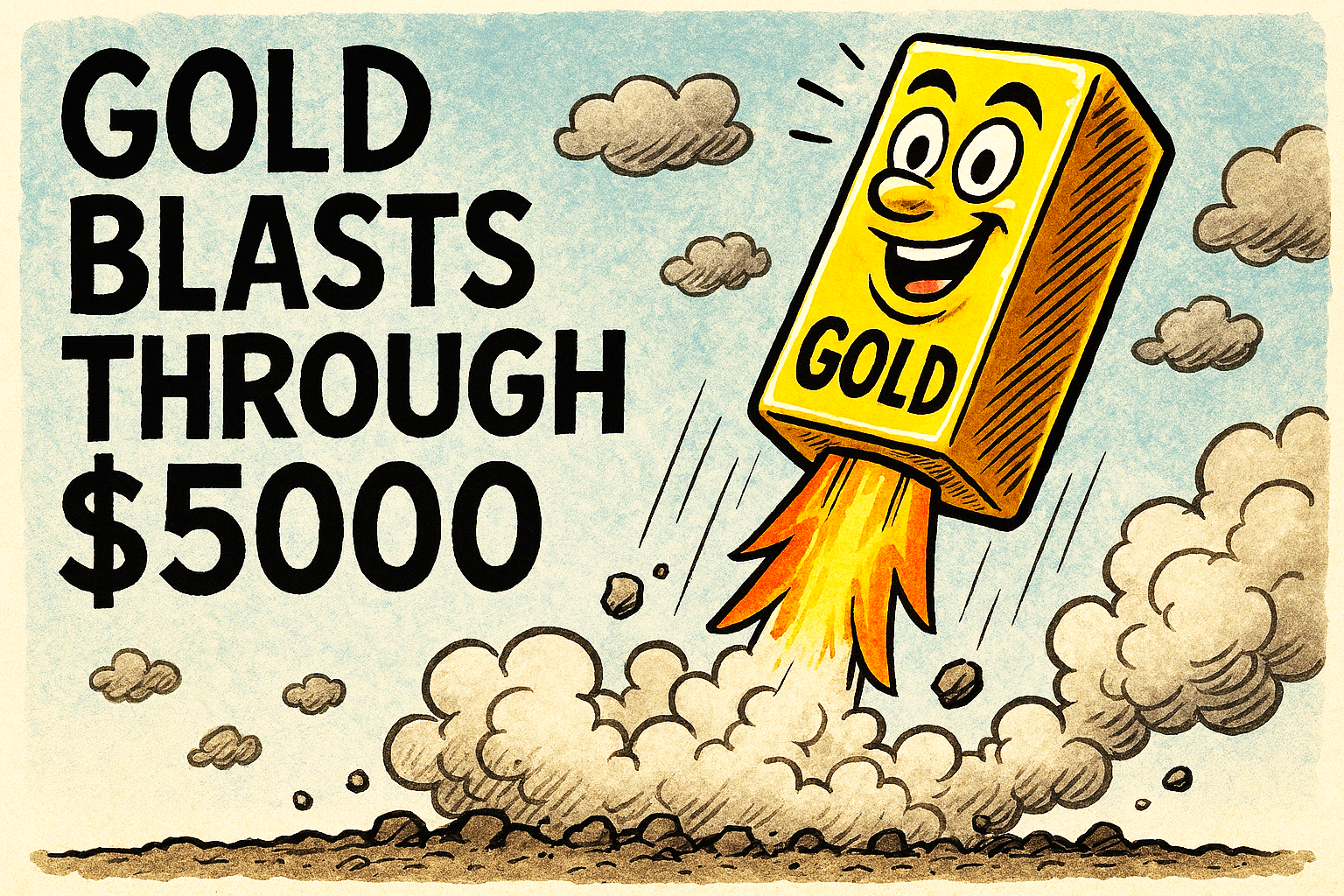
Gold break $5000 and moves higher

Gold takes off... again!

Gold’s dramatic surge through the $5,000 per ounce barrier has reshaped the market mood, signalling a profound shift in global investor psychology.

The metal’s ascent, driven by escalating geopolitical tensions and a deepening crisis of confidence in traditional assets, has pushed prices to unprecedented territory.

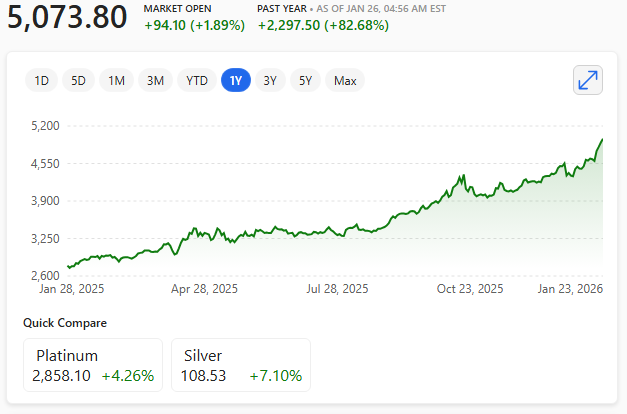
Recent trading saw spot gold climbing above $5,080, extending a rally that delivered a remarkable 64% rise in 2025 and strong gains again this year.

Analysts point to a potent mix of safe‑haven demand, monetary policy uncertainty, and sustained central‑bank buying as the forces behind this historic move.

China’s continued accumulation of reserves and record inflows into gold‑backed funds have added further momentum.

Gold one-year chart 26th January 2026

For many investors, gold has become the ultimate hedge against volatility, political disruption, and weakening confidence in government bonds and major currencies.

With tensions still simmering, the gold’s trajectory suggests this rally may not be over yet.

Some analysts speak of a not-too-distant future $7000 per ounce price tag.

From Missiles to Tariffs: A desensitised stock market faces Trump’s new world

Markets desensitised to U.S. policy making

In years past, the mere hint of U.S. airstrikes or heightened geopolitical tension would send global stock markets into panic mode.

Yet, following President Trump’s re-election and his increasingly aggressive foreign policy stance, investor reactions have become notably muted.

From missile strikes on Iranian nuclear sites to an orchestrated ceasefire between Iran and Israel, markets have barely flinched. The question arises: are investors becoming desensitised to Trump’s geopolitical theatre?

Take the latest skirmish between Iran and Israel. After nearly two weeks of missile exchanges, Trump’s announcement of a ‘complete and total ceasefire’ barely nudged the S&P 500.

That calm came despite the U.S. launching pre-emptive strikes on Iranian facilities and absorbing retaliatory attacks on its military base in Qatar.

In another era, or under a different administration even, such developments might have triggered a broad risk-off sentiment. Instead, Wall Street just shrugged.

One reason may be fatigue. Trump’s approach – rife with tariffs, sanctions, and sudden reversals – has bred a kind of market immunity.

Investors, well-versed in the rhythm of Trump’s provocations, have begun treating them as background noise. His revived tariff agenda, particularly the threats aimed once again at China and EU auto imports, has likewise failed to prompt major selloffs.

Similarly, the ongoing Russia-Ukraine conflict, once a source of intense volatility, now registers as a strategic stalemate in the market’s eyes.

While Trump’s rhetoric surrounding Ukraine has shifted unpredictably, investors appear more focused on earnings, inflation data, and central bank signals than on diplomatic fallout and war!

This is not to suggest markets are indifferent to geopolitical risk, but rather that they’ve adapted. Algorithmic trading models may be increasingly geared to discount Trump’s headline-grabbing tactics, while institutional investors hedge through gold, volatility indices, or energy plays without dumping equities outright.

Critics argue this detachment is dangerous. Should a flashpoint spiral out of control, be it over Hormuz, Ukraine, or Taiwan, the slow-boiling complacency could leave portfolios badly exposed.

Still, for now, Trump’s policies are being priced in not with panic, but with complacency maybe.

The real story may not be what Trump does next, but how long the markets can continue to look away.

Trump announces he had brokered ceasefire between Israel and Iran?

Tensions between Israel and Iran reached a boiling point after 12 days of cross-border missile and drone strikes.

The situation escalated further when U.S. forces under President Trump launched targeted airstrikes on key Iranian nuclear sites, Fordow, Natanz, and Isfahan, prompting a direct Iranian missile response on a U.S. base in Qatar.

In a dramatic turn, President Trump announced what he called a ‘Complete and Total CEASEFIRE‘ – announced on Truth Social. According to Trump’s plan, Iran would begin the ceasefire immediately, with Israel to follow 12 hours later.

The truce would reportedly be considered complete after 24 hours if all attacks stopped.

While Trump touted the ceasefire as a triumph of ‘peace through strength’, analysts questioned the ceasefire’s enforceability – especially since missile exchanges reportedly continued despite the announcement.

Nonetheless, Trump claimed credit for halting the region’s slide into all-out war without committing to prolonged U.S. military involvement.

Critics argue Trump’s strategy relies more on military pressure and media theatrics than diplomatic engagement.

Supporters counter that his boldness forced both sides to the table. Either way, the world is watching to see whether this fragile peace endures – or erupts again in fire.

If this turns out to be a masterstroke in political brinkmanship – hats off to Trump, I guess. Whichever way you look at it, the precision U.S. strike on Iran was exactly that – precision. And, you have to take note.

Iran has been weakened, and this may even influence Russia’s war on Ukraine. Hopefully Israel with Palestine too – regardless of stock market reaction.

And that has to be a good thing!

But has Israel finished their war?

Despite all the noise regarding stock market reaction, one thing is for certain – the anxiety and worry for the people of the Middle East is unquestionable.

It’s not a happy time.

Slower and smaller-than-expected rate cuts. A slowing U.S. economy and a potential AI bubble – does this all add up to a coming bear market?

Witches' stocks cauldron

The stock markets mix of toil and trouble is in the cauldron ready for a bear market in 2025, if not before.

Why?

  • Fed to resist reducing rates to the market’s desired 3.50%.
  • Profits unlikely from now on to fulfill expectations, because the U.S. economy is slowing.
  • AI sector is in or close to ‘bubble territory’.
  • Debt.
  • Geopolitical concerns.

These concerns are now all combining, and it will likely add-up to a bear market of around 25% in 2025 (this is my best guess).

Remember – make your own decisions and always, always do your own careful research. Seek professional financial advice if in doubt.

RESEARCH! RESEARCH! RESEARCH!