Apple is reportedly engaged in negotiations to acquire a licence for Google’s Gemini, a generative AI platform, with the intention of integrating it into iPhones. These ongoing discussions may result in Gemini enhancing iPhone software with new features later this year.
The terms, branding, and implementation details have not been finalised. This potential partnership could significantly impact the AI capabilities of future iPhones.
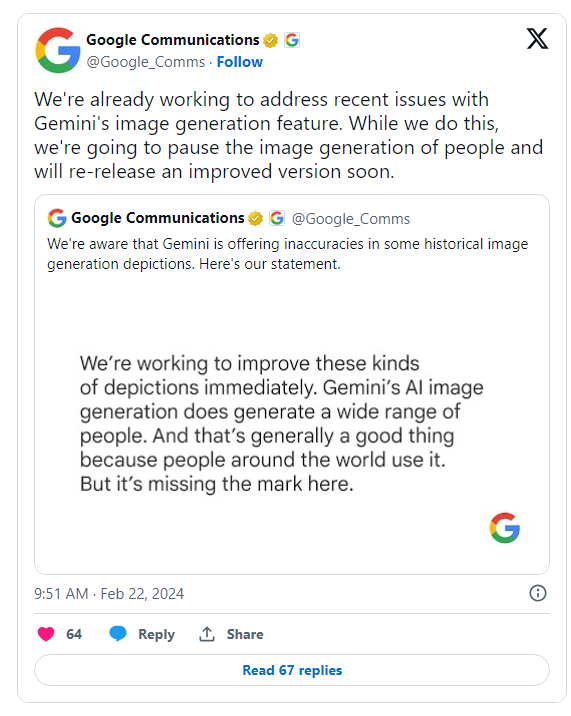
Google on Thursday 22nd February 2024 said it is pausing its Gemini artificial intelligence (AI) image generation feature after saying it offers ‘inaccuracies’ in historical pictures
Users had been reporting that the AI tool generated images of historical figures, like the U.S. Founding Fathers as people of colour, calling this inaccurate.
Google posted a statement on Thursday 22nd February 2024, saying that it will pause Gemini’s feature to generate images of people and will re-release an ‘improved’ version soon.
Is Google struggling to keep up with the AI race?
The image generator tool was launched at the start of February 2024 through Gemini, which was orignally called Bard.
It is facing challenges at a time when Google is trying to catch up with Microsoft-backed OpenAI project, Copilot.
The Magnificent Seven, or MAMA ANT, is a term coined by Bank of America to describe the seven most dominant tech companies in the world
The Seven are: Microsoft, Amazon, Meta Platforms, Apple, Nvidia, Tesla, and Alphabet. These companies have not only led the tech sector in terms of innovation, growth, and profitability, but have also become some of the most valuable entities in the world by market capitalization.
Valuation at $15 trillion
Market capitalization, or market cap, is the total value of all the shares of a company that are traded on the stock market. It reflects the market’s perception of the company’s future prospects and earnings potential.
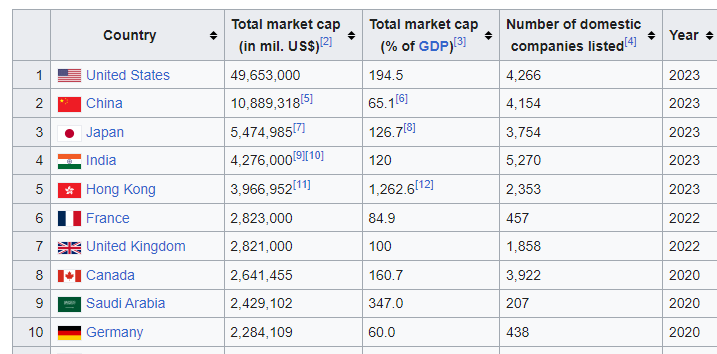
As of January 2023, the Magnificent Seven had a combined market cap of about $15 trillion, which was more than the gross domestic product (GDP) of almost every country in the world, except for the United States, China and Japan (just).
Magnificent Seven
The Magnificent Seven have achieved such a remarkable feat by leveraging their core competencies in various fields of technology, such as artificial intelligence (AI), cloud computing, social media, e-commerce, gaming, electric vehicles, and online advertising. They have also diversified their revenue streams by acquiring or developing new products and services, such as Activision Blizzard, AWS, Oculus, iPhone, GeForce, SpaceX, and YouTube. They have also benefited from the increased demand for digital solutions amid the Covid-19 pandemic, which accelerated the adoption of online platforms, remote work, and entertainment.
Challenges
However, the Magnificent Seven also face some challenges and risks that could threaten their dominance and valuation. These include increasing competition from other tech companies, especially from China, such as Alibaba, Tencent, Baidu, and Huawei.
They also face regulatory scrutiny and pressure from governments and consumers over issues such as antitrust, privacy, taxation, content moderation, and environmental impact. Furthermore, they may encounter technical difficulties, security breaches, or ethical dilemmas that could damage their reputation and customer trust.
Conclusion
In conclusion, the Magnificent Seven are the most powerful and influential tech companies in the world, and their market cap surpasses that of almost every country in the world.
List of 10 countries by stock market capitalization
List of 10 countries by stock market capitalisation
The meteoric rise in the profits and market capitalisations of the Magnificent 7 U.S. tech giants: Apple, Amazon, Alphabet, Meta, Microsoft, Nvidia and Tesla – outstrip those of all listed companies in almost every G20 country. Of the non-U.S. G20 countries, only China and Japan (and the latter, only just) have greater profits when their listed companies are combined.
They have achieved this by exploiting their competitive advantages in various domains of technology and expanding their offerings and markets. However, they also need to overcome some challenges and risks that could hamper their growth and value in the future.
A forced size reduction to stop the monopolising of market share could help tame these beasts too and open up fairer competition.
Should we worry?
Basically, yes, we should be concerned about the size and dominance of these companies.
This level of wealth and power concentrated in just a handful of companies has led some analysts to voice concerns over related risks in the U.S. and global stock markets.
Economists and stock market analysts have cautioned that the U.S. stock market is rivalling 2000 and 1929 in terms of being at its most concentrated in history.
Nasdaq 100 futures declined around 0.75%. S&P 500 futures were also down around 0.4%
In after-hours trading, shares of Alphabet dropped more than 5%, while Microsoft slipped 2% after the tech giants, part of the Magnificent Seven posted quarterly earnings. However, both companies achieved on both top and bottom lines. However, advertising revenue for Alphabet came short of analysts’ expectations.
Tech powerhouse
The tech sector powered the market rally from 2023 into 2024 and is now trading at a relatively high valuation of nearly 29 times its 2024 earnings, according to recent figures. Investors will need to see earnings expansion in order for the tech companies to be able to maintain their elevated levels.
Results were good but not good enough according to Wall Street as stocks were priced for perfection and that wasn’t delivered.
Even though the results were better-than-expected, investors are likely selling because they just want to take some money off the table.
Absolute perfection comes at a price on Wall Street.
Pressure mounts on the Google to demonstrate how it plans monetize AI.
Google has launched its largest and most capable (by its own admission) artificial intelligence (AI) model on Wednesday 6th December 2023 pressure mounts on the company to answer how it’ll monetize AI.
Gemini
The large language model Gemini will include a suite of three different sizes: Gemini Ultra, its largest, most capable category; Gemini Pro, which scales across a wide range of tasks; and Gemini Nano, which it will use for specific tasks and mobile devices.
Cloud
Google is reportedly planning to licence Gemini to clients through Google Cloud to use in their own applications. Developers and enterprise customers can access Gemini Pro via the Gemini API in Google AI Studio or Google Cloud Vertex AI.
Android
Android developers will also be able to build with Gemini Nano. Gemini will also be used to power Google products like its Bard Chatbot and Search Generative Experience, which tries to answer search queries with conversational-style text.
Ultra
Gemini Ultra is reportedly the first model to outperform human experts on MMLU(massive multitask language understanding), which uses a combination of 57 subjects such as math, physics, history, law, medicine and ethics for testing both world knowledge and problem-solving abilities, the company said in a blog post Wednesday 6th December 2023.
It can supposedly understand nuance and reasoning in complex subjects.
Advanced
The company gave examples demonstrating Gemini being able to take a screenshot of a chart and analyse hundreds of pages from research and then updating the chart.
Another example was analyzing a photo of a person’s math homework and identifying correct answers and pointing out incorrect ones.
The future is artificial.
Definition of the word Gemini: Constellation, Astrological Sign or Twins in Latin.
The Magnificent Seven is a term to describe seven tech’ stocks that have been surging in 2023.
Meta Platforms (formerly Facebook), the social media giant that also owns Instagram, WhatsApp, and Oculus.
Apple, the maker of the iPhone, iPad, Mac, Apple Watch, AirPods, and other popular devices and services including cloud and Apple TV streaming service.
Amazon, the e-commerce leader that also operates AWS, Prime Video, Alexa, and Whole Foods.
Alphabet, the parent company of Google, YouTube, Gmail, Google Cloud, and Waymo.
Microsoft, the software company that owns Windows, Office, Azure, LinkedIn, Xbox, and Teams.
Nvidia, the semiconductor company that produces graphics cards, gaming devices, data center solutions, and AI platforms.
Tesla, the electric vehicle maker that also develops solar panels, batteries, and autonomous driving technology.
Dominant
These seven stocks are considered to be dominant in their respective fields and have strong growth prospects driven by innovation and artificial intelligence (AI).
They have outperformed the broader market and attracted many investors who are looking for exposure to the tech’ sector. Some analysts believe that these stocks will continue to lead the market in the future, while others caution that they may face regulatory challenges, competition, or valuation issues.
Approximate combined market cap of the Magnificent Seven tech stocks
The approximate combined market cap value of the Magnificent Seven as of September 2023 is approximately $11.8 trillion.
Apple: $2.5 trillion
Microsoft: $2.3 trillion
Alphabet: $1.9 trillion
Amazon: $1.7 trillion
Nvidia: $0.8 trillion
Meta Platforms: $0.9 trillion
Tesla: $0.7 trillion
Note that these values will change over time as the stock prices fluctuate.
A way to trade the tech sector is through funds
There are many funds that can trade tech stocks, depending on your investment objectives, risk tolerance, and preferences.
Technology mutual funds: These are funds that invest in a diversified portfolio of technology companies across different industries, such as software, hardware, internet, cloud, biotech, and more. Technology mutual funds can offer exposure to the growth potential of the tech sector, as well as reduce the volatility and risk of investing in individual stocks.
Some examples of technology mutual funds are Fidelity Select Technology Portfolio (FSELX), Columbia Global Technology Growth Fund (CGTYX), and Schwab U.S. Large-Cap Growth Index Fund (SCHG).
Which tech fund to invest in?
Technology exchange-traded funds (ETFs): These are funds that track an index of technology stocks and trade on an exchange like a stock. Technology ETFs can offer low-cost and convenient access to the tech sector, as well as allow investors to choose from different themes, such as cybersecurity, artificial intelligence (AI), cloud computing and more.
Some examples of technology ETFs are Invesco QQQ Trust (QQQ), Technology Select Sector SPDR Fund (XLK), and VanEck Vectors Semiconductor ETF (SMH).
Technology index funds: These are funds that replicate the performance of a specific technology index, such as the Nasdaq 100, the S&P 500 Information Technology Index, or the Morningstar U.S. Technology Index. Technology index funds can offer broad and passive exposure to the tech sector, as well as low fees and high tax efficiency.
Some examples of technology index funds are Fidelity NASDAQ Composite Index Fund (FNCMX), Vanguard Information Technology Index Fund Admiral Shares (VITAX), and iShares Morningstar U.S. Technology ETF (IYW).
NOTE: These are not recommendations. Investments may go up or down. Your money is at risk!
Chip design firm Arm on 5th September 2023 submitted an updated filing for its upcoming initial public offering on the New York Stock Exchange, setting a price range between $47 and $51. Only 9.4% of Arm’s shares will be freely traded on the NYSE.
Arm was previously listed in London and New York, before SoftBank acquired it for $32 billion in 2016.
Chip design firm Arm on Tuesday is looking to acquire as much as $4.87 billion in its upcoming initial public offering on the New York Stock Exchange, according to the new filing.
The deal could value the company at as much as $52 billion
As a British company, Arm qualifies as a foreign private issuer in the U.S. and its shares will count as American depositary shares, or ADS’s. It is reported that the company will list some 95.5 million ADS’s at a price range of between $47 and $51. At the upper end of that range it is estimated that Arm will likely raise up to $4.87 billion. At the lower end, the IPO would fetch $4.49 billion of fresh capital for Arm. It could do even better.
Institutional funds
When the company floats in New York, it will look to enjoy a very deep pool of professional institutional funds. Arm seeks to ramp up its investments in research and development, particularly as it pursues growth in the artificial intelligence (AI) space with some of its newer chips. The company recently released new chips specifically targeted at AI and machine learning use cases.
Arm seeks up to $52 billion valuation in U.S. IPO
Upper end
At the upper end of the pricing range, Arm would also touch a total valuation of $52 billion or more. Only 9.4% of Arm’s shares will be freely traded on the New York Stock Exchange, with SoftBank expected to own roughly 90.6% of the company’s outstanding shares after the completion of the IPO.
Arm’s listing is set to be the biggest technology IPO of the year. Investors are hoping that the listing could breathe new life into an IPO market that has been ‘slack’ since 2022.
250 billion chips globally
Arm says its energy-efficient processor designs and software platforms are integrated into more than 250 billion chips globally, into products ranging from sensors and smartphones to supercomputers.
The company estimates it enjoys approximately 48.9% share of the market for semiconductor design. Other players, such as Intel and AMD, have raced to catch up on designing their own chip architectures, but have struggled so far.
U.K. misses out… again
The U.K. government had originally hoped Arm would list on the London Stock Exchange, but the company instead dealt a major blow to Britain’s ambitions to become the leading global tech hub by opting for New York. The U.S. financial center has a deep institutional investor base and analysts who have a close understanding of the technology sector.
BIG interest
Chip design firm Arm said in a Tuesday filing that Apple, Google parent Alphabet, Nvidia and other technology companies are interested in buying up to $735 million in its shares as it seeks to go public on Nasdaq.
The investments might not happen, but the fact that these companies are considering them underlines the importance of Arm, whose designs are used for processors in data center servers, consumer devices and industrial products.
Arm chip – some 250 billion chips globally
Chip makers Intel, Samsung and TSMC are interested in investing alongside the three trillion-dollar technology companies, along with AMD and MediaTek, which make chip designs based on Arm architectures. Cadence Design Systems and Synopsys, which make electronic design automation software for processor development, have also expressed interest, according to a revised prospectus for Arm’s shares sale. This IPO could easily be the biggest of the 2023!
As part of the deal, Arm could wind up with a $52 billion market capitalization and almost $5 billion in new cash.
This is likely to be the biggest IPO of 2023
It is estimated that there will be about 19 billion devices using the Arm processor in the world by the end of 2023.
Arm target
The market share of Arm across different technology markets worldwide, which was 90% for mobile application processors, 34% for embedded computing, and 5% for data center and cloud in 2019.
Arm has a target of increasing its market share to more than 90%, 50%, and 25% respectively by 2028.