

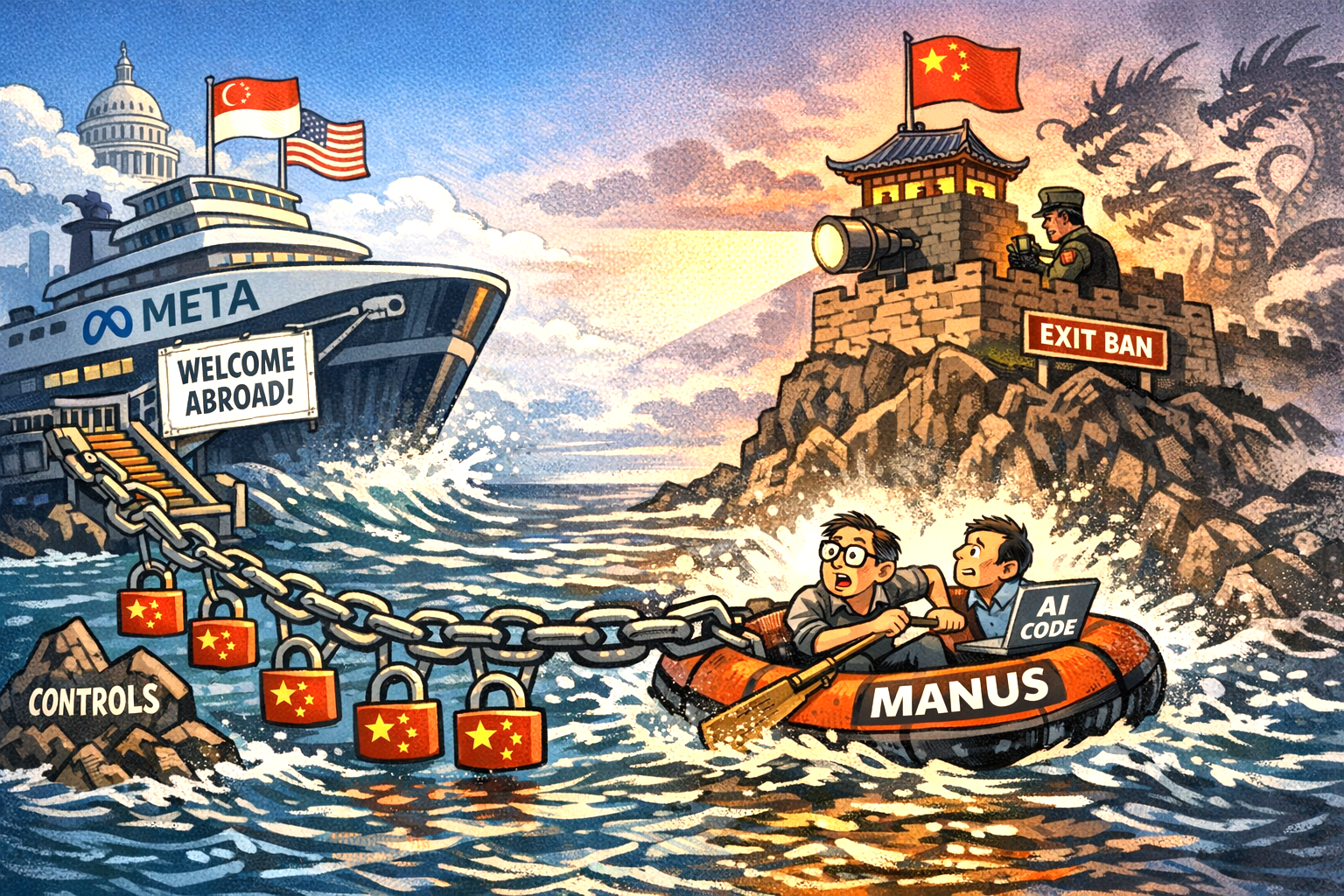
For years, Chinese AI founders comforted themselves with a simple fiction: that geography could outrun politics.
Move the holding company to Singapore, hire a few local staff, raise money from Silicon Valley, and the gravitational pull of Beijing’s regulatory state would somehow weaken. Manus was the poster child of that belief — until it wasn’t.
Meta’s $2 billion acquisition was supposed to be the triumphant proof that “Singapore washing” worked. Instead, Beijing’s sudden intervention has exposed it as a mirage.
Review
The Chinese government’s review of the deal — and the exit bans placed on Manus’ co‑founders — is more than a bureaucratic hurdle.
It is a declaration that the origin of a technology matters more than the passport of the company that later owns it.
The symbolism is striking. Manus built its early code in China, then attempted to transplant its identity offshore. But Beijing is now signalling that code, data and talent are not so easily detached from their birthplace.
The message to founders is blunt: you cannot simply shed China like an old skin.
Timing
For META, the timing is awkward. More than 100 Manus employees have already been folded into its Singapore office, and the company insists the deal complies with the law.
Yet the spectre of an unwinding hangs over the transaction — a reminder that even the world’s largest tech firms are not insulated from geopolitical weather.
The deeper story, though, is about the shrinking space for neutrality. The U.S.–China tech rivalry has moved beyond chips and compute into the realm of corporate identity itself.
Where a company is born, where its engineers sit, where its early investors come from — all now carry political charge.
Manus is not just a case study. It is a warning flare. In an era where innovation crosses borders but regulation does not, the idea of a clean escape route is fading fast.