
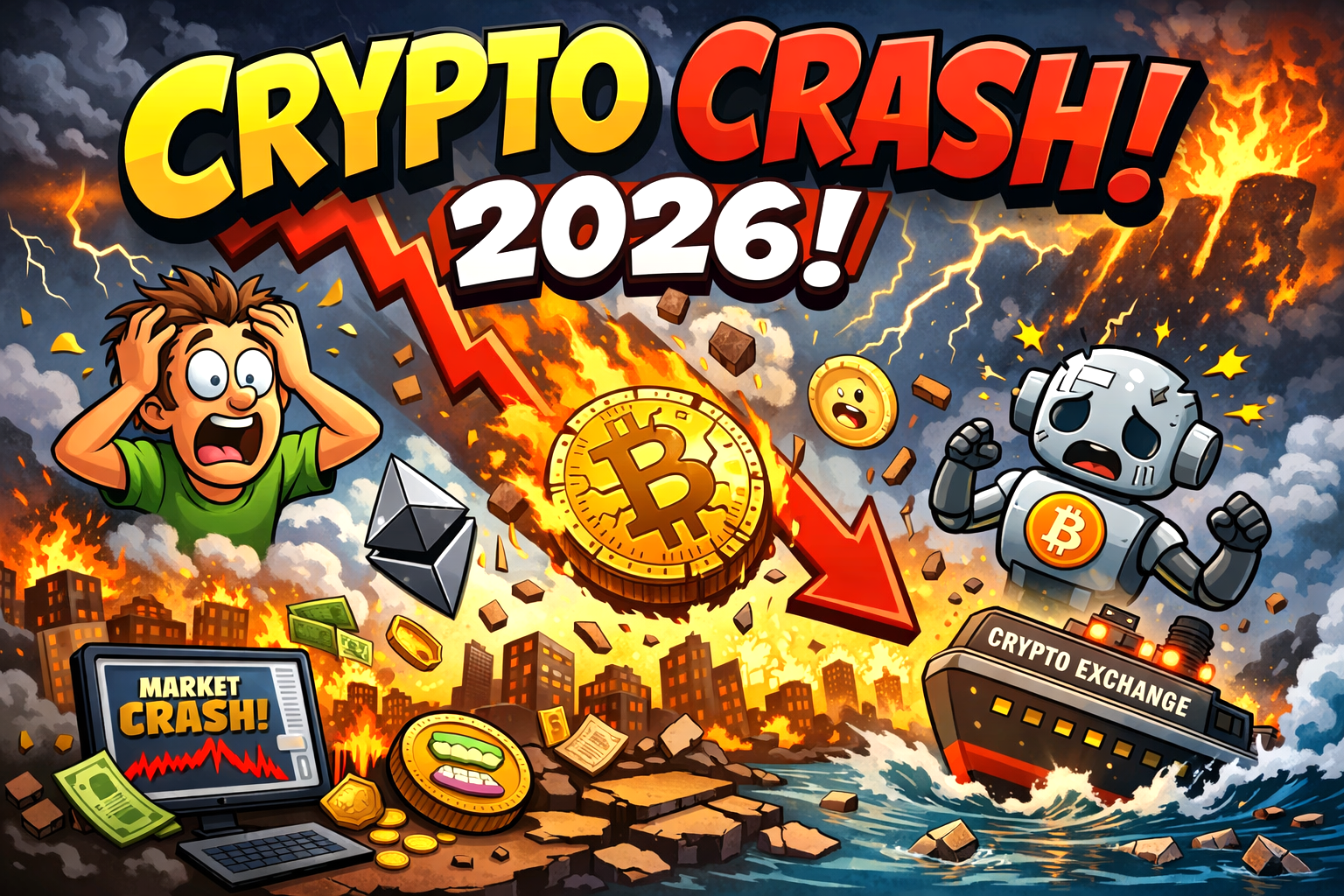
Crypto Crash 2026!

Crypto chaos!

The crypto markets have entered one of their most turbulent phases since the 2022 downturn, and the shockwaves are rippling far beyond digital‑asset circles.

What’s unfolding right now is not just another correction but a full‑scale confidence crisis, fuelled by regulatory pressure, liquidity stress, and a sharp reversal in investor sentiment.

Collapse

At the centre of the storm is the sudden collapse in major token prices. Bitcoin has plunged after months of stagnation, breaking through key psychological floors and triggering a cascade of automated sell‑offs.

Ethereum has followed suit, dragged down by concerns over declining network activity and the unwinding of leveraged positions across decentralised finance platforms.

Altcoins, as usual, have suffered the most, with many losing more than half their value in a matter of days.

Regulators have added fuel to the fire. Several governments have announced new enforcement actions targeting exchanges, stablecoin issuers, and offshore trading platforms.
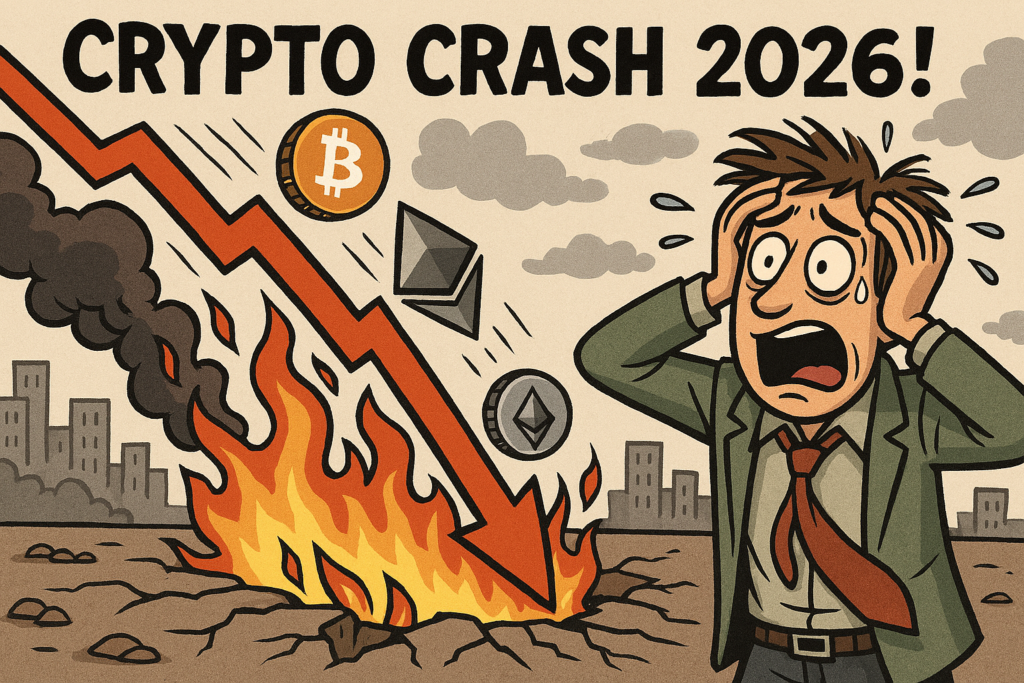
Jittery

Markets were already jittery, but the latest wave of investigations has amplified fears that the era of lightly regulated crypto speculation is coming to an abrupt end.

For institutional investors—who had cautiously re‑entered the market over the past two years—this has been enough to send them back to the sidelines.

Liquidity

Liquidity is evaporating as a result. Major exchanges are reporting thinner order books, wider spreads, and surging withdrawal volumes.

Some platforms have temporarily halted certain services to stabilise operations, which has only deepened public anxiety.

Retail traders, many of whom returned during the 2025 bull run, are now facing steep losses and scrambling to exit positions.

Yet amid the chaos, a familiar pattern is emerging. Developers continue to build, long‑term holders remain unfazed, and venture capital is quietly positioning for the next cycle.

Crypto has weathered dramatic crashes before, and each downturn has ultimately reshaped the industry rather than destroyed it.

The question now is not whether the sector will survive, but what form it will take when the dust finally settles.
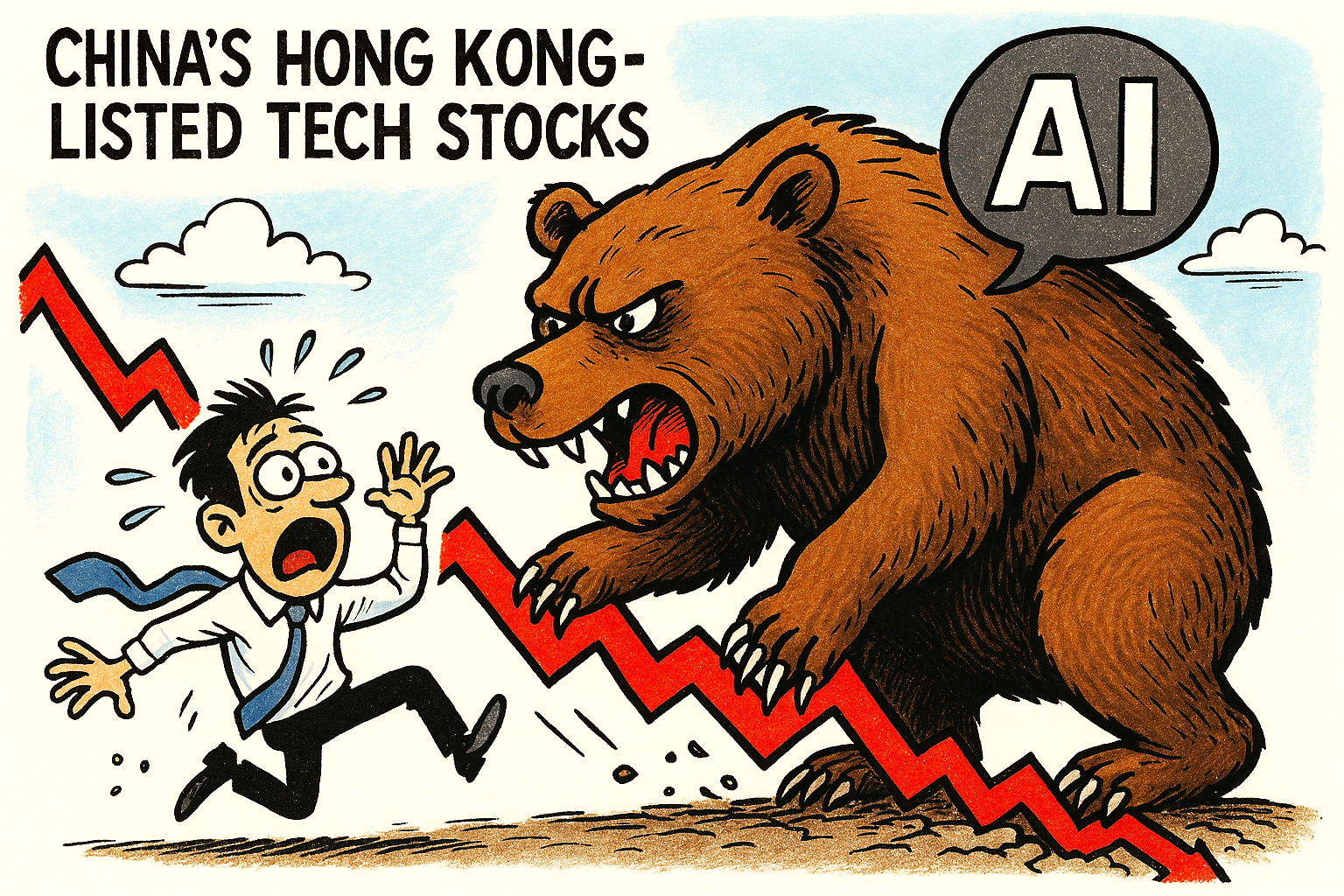
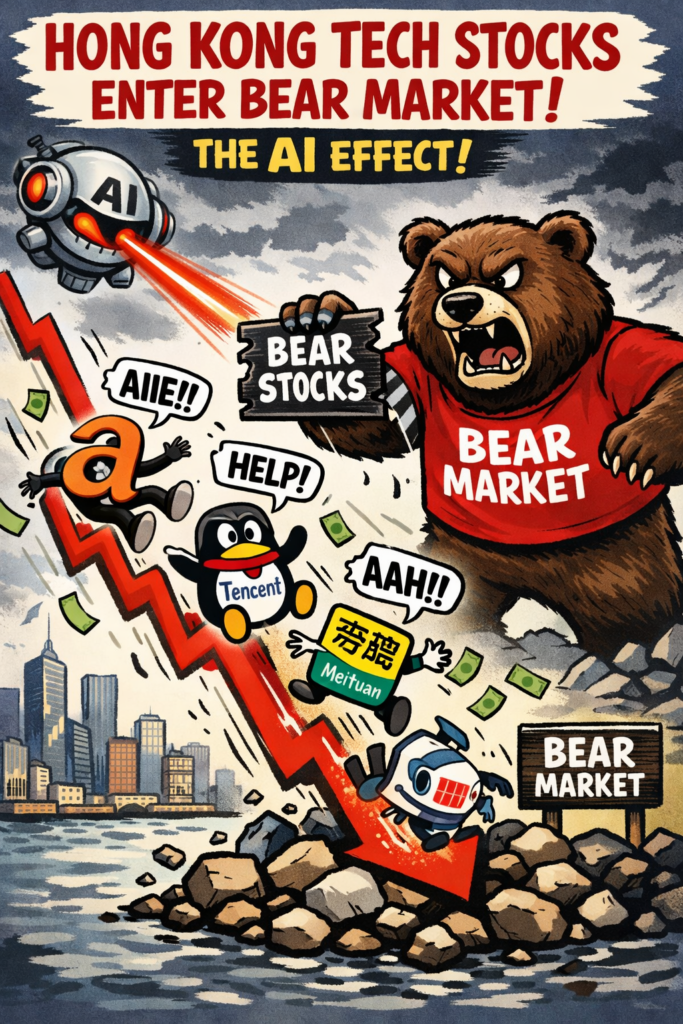
China’s Tech Rout: The AI Effect Moves to Centre Stage

Tech and AI stocks hit bear territory on the Hong Kong Hang Seng

China’s Hong Kong‑listed tech stocks have slipped decisively into a bear market, with the Hang Seng Tech Index now more than 20% below its October 2025 peak.

The downturn is being driven by a potent mix of tax concerns and global anxiety over the disruptive pace of artificial intelligence.

China’s Hong Kong‑listed technology sector has entered a sharp reversal after last year’s rally, with the Hang Seng Tech Index falling and officially breaching bear‑market territory.

The decline reflects a broader shift in sentiment as investors reassess the risks facing the sector.

AI Disruption and Global Risk Aversion

While tax worries have been widely cited, the global ‘AI effect’ is proving equally influential. Investors are increasingly concerned that rapid advances in artificial intelligence could reshape competitive dynamics across the tech landscape.

Companies perceived as lagging in AI development face heightened scrutiny, while uncertainty over regulatory responses adds further pressure.

This has contributed to a wave of risk aversion, particularly toward Chinese firms already navigating geopolitical and policy headwinds.

Policy Anxiety and VAT Concerns

Fears of potential tax hikes — including a possible increase in value‑added tax on internet services — have amplified the sell‑off.

Recent VAT changes in telecom services have made markets more sensitive to policy signals, prompting investors to reassess earnings expectations for major platform companies.

A Reversal of Momentum

The speed of the downturn has surprised many, given the strong rebound seen in 2025. Yet the combination of AI‑driven uncertainty, shifting regulatory expectations, and global market caution has created a challenging backdrop for Chinese tech stocks.

With sentiment fragile, analysts warn that volatility may persist until investors gain clearer visibility on both policy direction and the sector’s ability to adapt to accelerating AI disruption.

Is it coming to western stocks – especially in the U.S.?

It’s certainly possible that a similar dynamic could wash across Western markets, though not necessarily in the same form.

The extraordinary concentration of returns in a handful of U.S. mega‑cap AI leaders has created a structural imbalance: if investors begin to doubt the durability of AI‑driven earnings, or if regulatory pressure intensifies, the correction could be sharp because so much capital is leaning in the same direction.

Europe, meanwhile, faces a different vulnerability — a chronic under‑representation in frontier AI, which could leave its tech sector exposed if global capital rotates aggressively toward firms with demonstrable AI scale.

None of this guarantees a bear market, but the ingredients are present: stretched valuations, high expectations, and a technology cycle moving faster than many business models can adapt.

U.S. software companies are gradually feeling the impact—how long before the U.S. AI sector experiences a correction?

The Coming Crunch: Could AI Face a Global Memory Shortage?

Looming AI memory shortage

The rapid acceleration of artificial intelligence has created an unexpected bottleneck that few outside the semiconductor world saw coming.

A potential shortage of the high‑bandwidth memory (HBM) that modern AI systems depend upon has become a real issue.

As models grow larger and more capable, their appetite for memory grows even faster. The result is a looming constraint that could shape the pace, cost, and direction of AI development over the next five to ten years.

The issue

At the centre of the issue is the simple fact that AI models are no longer limited by compute alone. Training and running advanced systems require vast quantities of specialised memory capable of moving data at extraordinary speeds.

Only a handful of manufacturers produce HBM, and scaling production is slow, expensive, and technically demanding.

Even with aggressive investment, supply cannot instantly match the explosive demand driven by AI labs, cloud providers, and data centres.

The growing number of companies building on these models is only adding to the concerns.

If shortages intensify, the effects could ripple widely. Training costs may rise as competition for memory pushes prices higher.

Smaller companies could find themselves priced out of cutting‑edge development, deepening the divide between the largest AI players and everyone else. Hardware roadmaps might slow, forcing engineers to prioritise efficiency over sheer scale.

AI deceleration?

In the most constrained scenarios, progress in frontier AI could decelerate simply because the physical components required to build it are unavailable.

Is this crisis inevitable? Not necessarily. The semiconductor industry has a long history of overcoming supply constraints through innovation, investment, and new fabrication techniques.

Alternative memory architectures, improved model‑compression methods, and more efficient training strategies are already being explored.

Yet the demand curve remains steep, and the next few years will test whether supply chains can keep pace with AI’s ambitions.

A genuine memory crunch is not guaranteed, but it is plausible enough that the industry is treating it seriously.

If nothing else, it highlights a truth often forgotten in the excitement created around new technological developments, in this case… AI.

Even the most advanced intelligence still relies on very real, very finite physical infrastructure.

SpaceX–xAI: A New Age Industrial Giant

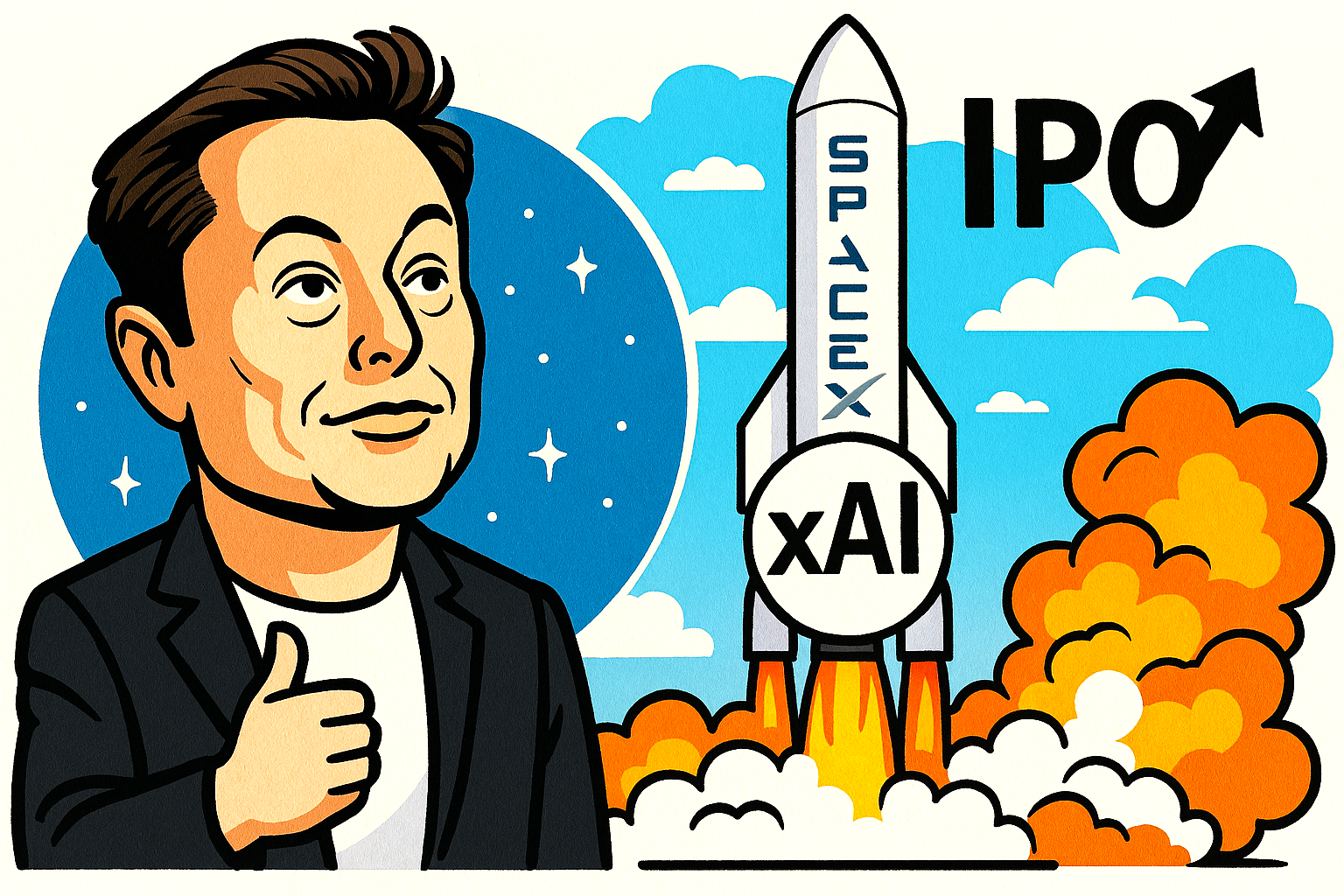
IPO for SpaceX and xAI

Elon Musk’s decision to fold xAI into SpaceX has set the stage for what could become one of the largest and most closely watched IPOs in market history.

The move signals a bold attempt to fuse advanced artificial intelligence with orbital infrastructure, satellite communications, and Musk’s wider technological ecosystem.

Elon Musk’s merger of SpaceX with his artificial intelligence venture xAI marks a decisive shift in the trajectory of both companies.

Integrated power

The combined entity is now positioned as a vertically integrated powerhouse spanning rockets, space‑based internet, direct‑to‑mobile communications, and frontier AI research.

Musk has described the unified structure as an ‘innovation engine’ capable of accelerating progress both on Earth and beyond.

The strategic logic is clear: AI requires immense computational resources, and Musk believes space‑based compute will become the most cost‑effective solution within a few years.

By bringing xAI under SpaceX’s umbrella, he gains the ability to scale AI training using satellite infrastructure while consolidating governance, data flows, and long‑term capital planning.

A Trillion‑Dollar Listing on the Horizon

The merged company is expected to pursue an IPO valued at roughly $1.25 trillion, with share pricing estimates placing it among the most valuable listings ever attempted.

Early reports suggest the offering could raise as much as $50 billion, instantly making it one of the largest capital‑market events in history.

Such a valuation reflects not only SpaceX’s dominance in commercial launch and satellite internet, but also the rapid rise of xAI’s Grok chatbot and its integration with Musk’s social platform, X.

The consolidation also concentrates financial scrutiny, with analysts noting that the new structure brings unprecedented transparency demands for a company that has historically operated privately.

Innovation

One of the most radical implications of SpaceX absorbing xAI is the potential to relocate data centres into orbit.

Musk has long argued that space-based compute could dramatically reduce cooling costs, thanks to the natural vacuum and thermal dissipation of low Earth orbit.

By leveraging Starlink’s satellite mesh and SpaceX’s launch cadence, the merged entity could deploy AI training clusters above the atmosphere—sidestepping terrestrial energy constraints and redefining the economics of large-scale artificial intelligence.

This vision, while technically ambitious, aligns with Musk’s broader strategy of vertical integration and frontier infrastructure.

The Stakes

If successful, the IPO will redefine the market landscape for both aerospace and artificial intelligence.

It represents a bet that the future of AI will be built not just in data centres, but in orbit—an audacious vision even by Musk’s standards.

The Rise of OpenClaw and the New Era of AI Agents

Agent AI

A new generation of artificial intelligence is taking shape, and at its centre sits OpenClaw — a fast‑evolving framework that embodies the shift from monolithic AI models to agile, task‑driven agents.

While large language models once dominated the conversation, the momentum has clearly moved toward systems that can reason, plan, and act with far greater autonomy. OpenClaw is emerging as one of the most intriguing examples of this transition.

Appeal

OpenClaw’s appeal lies in its modular design. Instead of relying on a single, all‑purpose model, it orchestrates multiple specialised components that collaborate to complete complex workflows.

This mirrors how real teams operate: one agent may handle research, another may draft content, and a third may evaluate quality or flag risks. The result is a system that behaves less like a tool and more like a coordinated digital workforce.

Defining trend

This shift is not happening in isolation. Across the industry, AI agents are becoming the defining trend. Companies are racing to build systems that can manage inboxes, run businesses, write and deploy code, or even negotiate with other agents.

The ambition is no longer to create a chatbot that answers questions, but an autonomous entity capable of executing multi‑step tasks with minimal human intervention.

OpenClaw stands out because it embraces openness and experimentation. Developers can plug in their own models, customise behaviours, and build agent ‘stacks’ tailored to specific industries.

Adoption

Early adopters in media, finance, and logistics are already exploring how these agents can streamline research, automate reporting, or coordinate supply‑chain decisions.

The promise is efficiency, but also creativity: agents that can generate ideas, test them, and refine them without constant supervision.

Of course, the rise of agentic AI brings challenges. Questions around safety, reliability, and accountability are becoming more urgent. An agent that can act independently must also be constrained responsibly.

Challenge

The industry is now grappling with how to balance autonomy with oversight, ensuring that these systems remain aligned with human goals and values.

Even with these concerns, the trajectory is unmistakable. OpenClaw and its peers represent a decisive step toward AI that is not merely reactive but proactive — capable of taking initiative, managing complexity, and collaborating with humans in more meaningful ways.

As these systems mature, they are likely to reshape not just how we work, but how we think about intelligence itself.

If you want to explore how this trend could influence your editorial or creative workflows, I’m ready to dive deeper with you.

The ups and downs of Gold and Silver as prices collapse from record highs

Gold and silver - the ups and downs!

The precious metals market has endured one of its most dramatic reversals in modern trading history, with gold and silver plunging from last week’s extraordinary peaks to deep intraday lows.

Gold, which surged to an unprecedented $5,600 per ounce, fell back to around $4,500, while silver has retreated from highs near $120 per ounce to roughly $74 in intraday trading.

The scale and speed of the correction have rattled traders and forced a reassessment of what drove the rally — and what comes next.

Why the collapse happened

The initial surge in both metals was fuelled by a potent mix of safe‑haven demand, speculation, and expectations of looser U.S. monetary policy and new Federal Reserve chair.

As gold broke above $4,500 for the first time in late December, speculative interest intensified, pushing prices into what now looks like a classic blow‑off top.

But the reversal began when sentiment shifted abruptly. A stronger U.S. dollar, firmer Treasury yields, and a wave of profit‑taking created the first cracks.

Once prices started to slip, leveraged positions in futures markets were forced to unwind. This triggered cascading sell orders, accelerating the decline.

Silver, which had risen even more aggressively than gold, suffered one of its steepest percentage drops since 1980.

How the sell‑off unfolded

The correction was not a slow bleed but a violent, liquidity‑draining plunge. Gold fell more than $1,000 per ounce from peak to trough, while silver shed $40–$45.

These moves were amplified by algorithmic trading systems that flipped from buying momentum to selling weakness as volatility spiked.

The fact that gold briefly and recently traded below $4,800 and silver below $100 before extending losses to their intraday lows shows how thin market depth became during the heaviest selling.

Even long‑term holders, typically slow to react, contributed to the pressure as stop‑loss levels were triggered.

What happens next

Despite the severity of the drop, the fundamental drivers that supported the earlier rally have not disappeared.

Concerns over global debt levels, geopolitical instability, and central bank diversification into gold remain intact. However, the market must now digest the excesses of the speculative surge.

In the short term, volatility is likely to remain elevated. A stabilisation phase — potentially lasting weeks — may be needed before a clearer trend emerges.

If the dollar strengthens further or yields continue rising, metals could retest their recent lows. Conversely, any signs of economic softening or renewed policy easing could attract dip‑buyers back into the market.

For now, the message is clear: even in a bull market, precious metals can still deliver brutal corrections — and timing remains everything.

Note: Friday to Monday (30th January to 2nd February 2026)

And… watch for the rebound.