

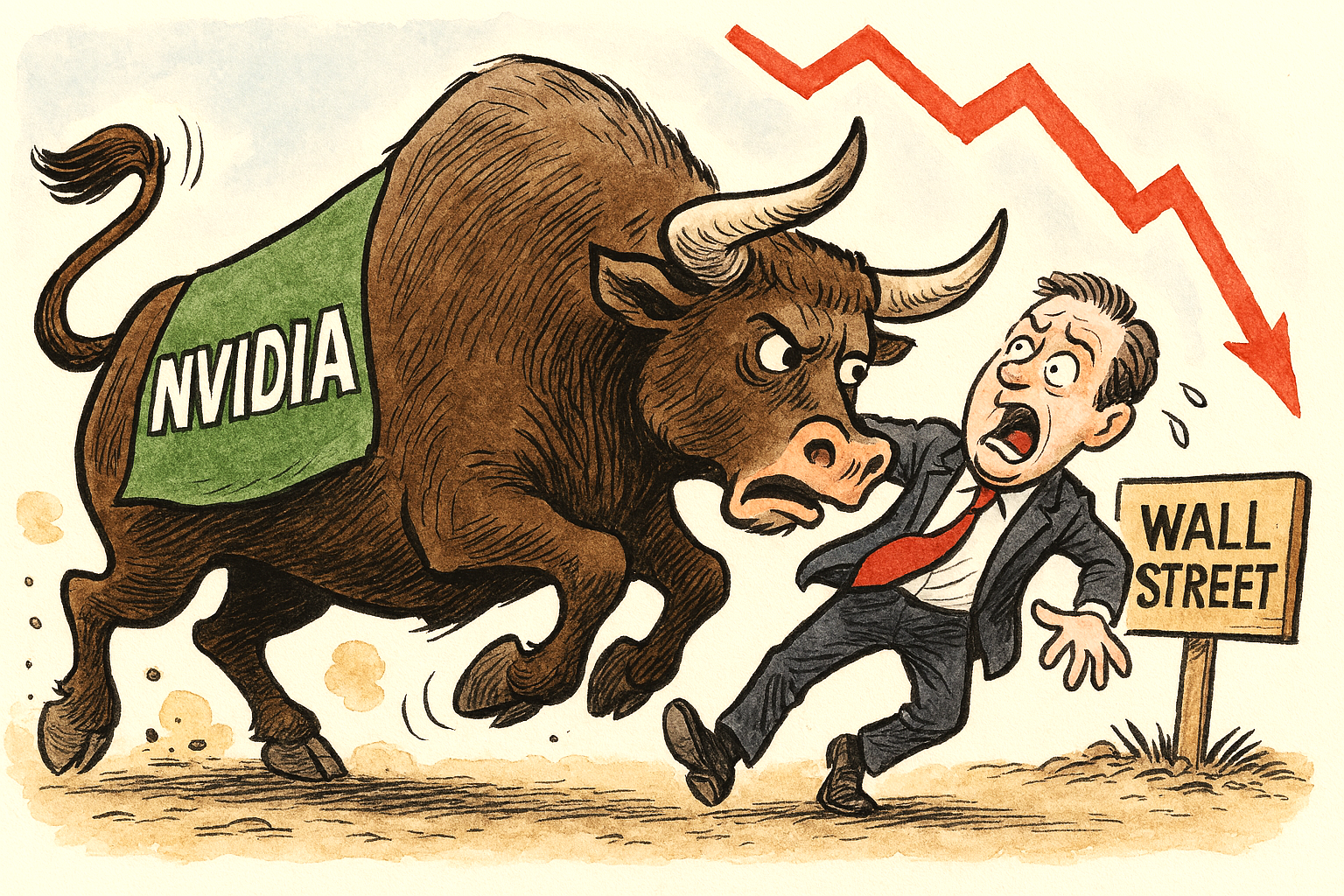
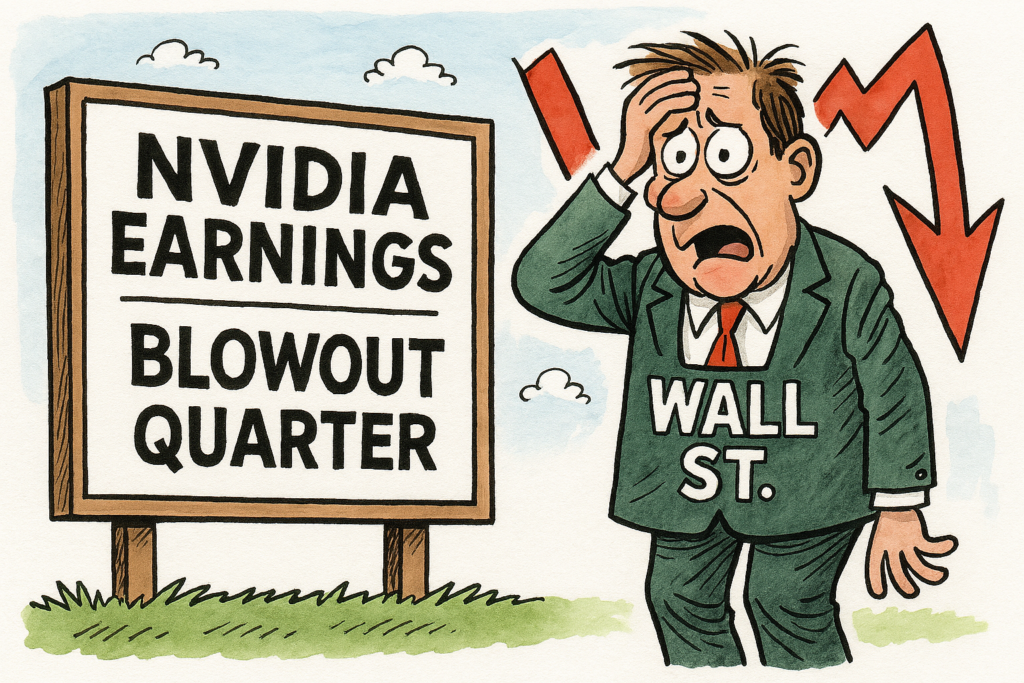
Nvidia’s earnings didn’t disappoint on the numbers — they were spectacular — but Wall Street was disappointed by the guidance, the pricing signals, and the shift in the AI‑chip cycle, which is why the stock fell despite a blowout quarter.
Nvidia’s latest quarterly results were, on the surface, extraordinary. Revenue surged, margins remained enviably high and demand for its AI chips continued to reshape the global technology landscape.
Yet the company’s shares fell sharply, dragging broader markets with them. The reaction reflects a deeper unease on Wall Street: not about what Nvidia has achieved, but about what comes next.
The company delivered a blowout quarter, but investors were looking for something even more explosive.
Cooling expectations after a year of euphoria
Nvidia has become the defining stock of the AI boom, and with that status comes a valuation that assumes relentless acceleration.
This quarter’s guidance, while strong, suggested growth is beginning to normalise. Investors who had priced in another step-change in demand instead saw signs of a company settling into a more sustainable—though still impressive—trajectory.
In a market conditioned to expect perpetual hyper‑growth, “very strong” can feel like a disappointment.
Fears of peak pricing power
A second concern is whether Nvidia’s extraordinary pricing power is nearing its peak. The company’s flagship AI chips have commanded eye‑watering prices, but cloud providers and enterprise customers are now signalling resistance.
Competitors are improving, and hyperscalers are accelerating development of their own silicon.
Some analysts are asking – whether the industry has already seen the high‑water mark for Nvidia’s margins, a question that goes straight to the heart of the stock’s valuation.
China remains a structural drag
Regulatory constraints continue to weigh on Nvidia’s China business. The company has not yet been able to meaningfully sell its U.S. approved AI chips into the market, and executives have warned that local rivals could fill the gap.
China was once a major contributor to Nvidia’s data‑centre revenue; now it is a source of uncertainty. Investors are increasingly factoring in the possibility that this revenue may not return in its previous form.
A crowded trade unwinds
Finally, Nvidia’s sell‑off reflects positioning as much as fundamentals. The stock has been one of the most crowded trades in global markets.
When expectations are stretched, even exceptional results can trigger profit‑taking. The pullback spilled into broader indices, with Asia‑Pacific markets trading mixed as investors digested the slump.
Nvidia remains the central force in the AI hardware boom, but Wall Street is beginning to ask harder questions about sustainability, competition and the next phase of growth.