

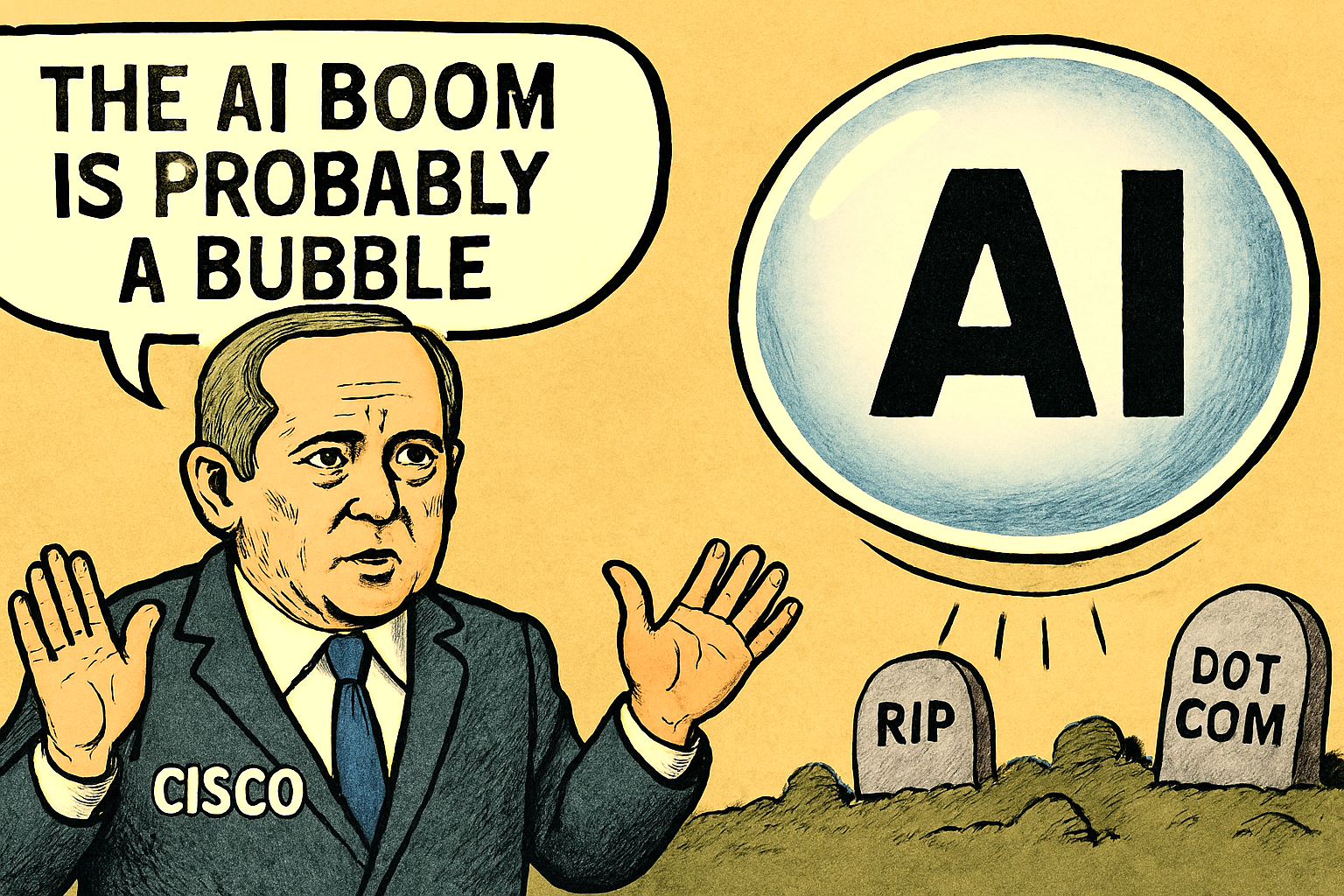
Cisco’s chief executive, Chuck Robbins, has issued one of the clearest assessments yet of the frenzy surrounding artificial intelligence, arguing that the sector is ‘probably’ in bubble territory even as it lays the foundations for a technological shift larger than the internet itself.
Speaking in a recent interview, Robbins said the scale of investment pouring into AI start‑ups and infrastructure mirrors the exuberance of the late‑1990s dot‑com era.
Back then, vast sums of capital chased unproven ideas, leading to a dramatic market crash. Yet the companies that survived went on to define the modern digital economy.
Caution!
Robbins believes AI is following a similar trajectory: inflated expectations today, followed by a period of painful consolidation, and ultimately a handful of dominant players reshaping global industries.
He cautioned that many firms currently attracting funding will not endure. The rush to build models, platforms and specialised hardware has created what he described as ‘inevitable carnage’ ahead, as weaker businesses fail to convert hype into sustainable products.
Even so, he stressed that the underlying technology is transformative, with applications spanning healthcare, manufacturing, cybersecurity and national infrastructure.
Embedded AI
Cisco itself is deeply embedded in the AI supply chain, providing networking systems capable of handling the enormous data flows required to train and deploy advanced models.
Robbins said demand for high‑performance infrastructure continues to accelerate, driven by cloud providers and enterprises racing to integrate AI into their operations.
Despite the risks, he argued that dismissing AI as a passing bubble would be a mistake. The coming shake‑out, he suggested, is simply part of the cycle that accompanies every major technological revolution.
Once the dust settles, the companies that remain will be those with genuine innovation, strong business models and the capacity to scale globally.