
U.S. AI vs China AI – the difference

China and U.S. AI

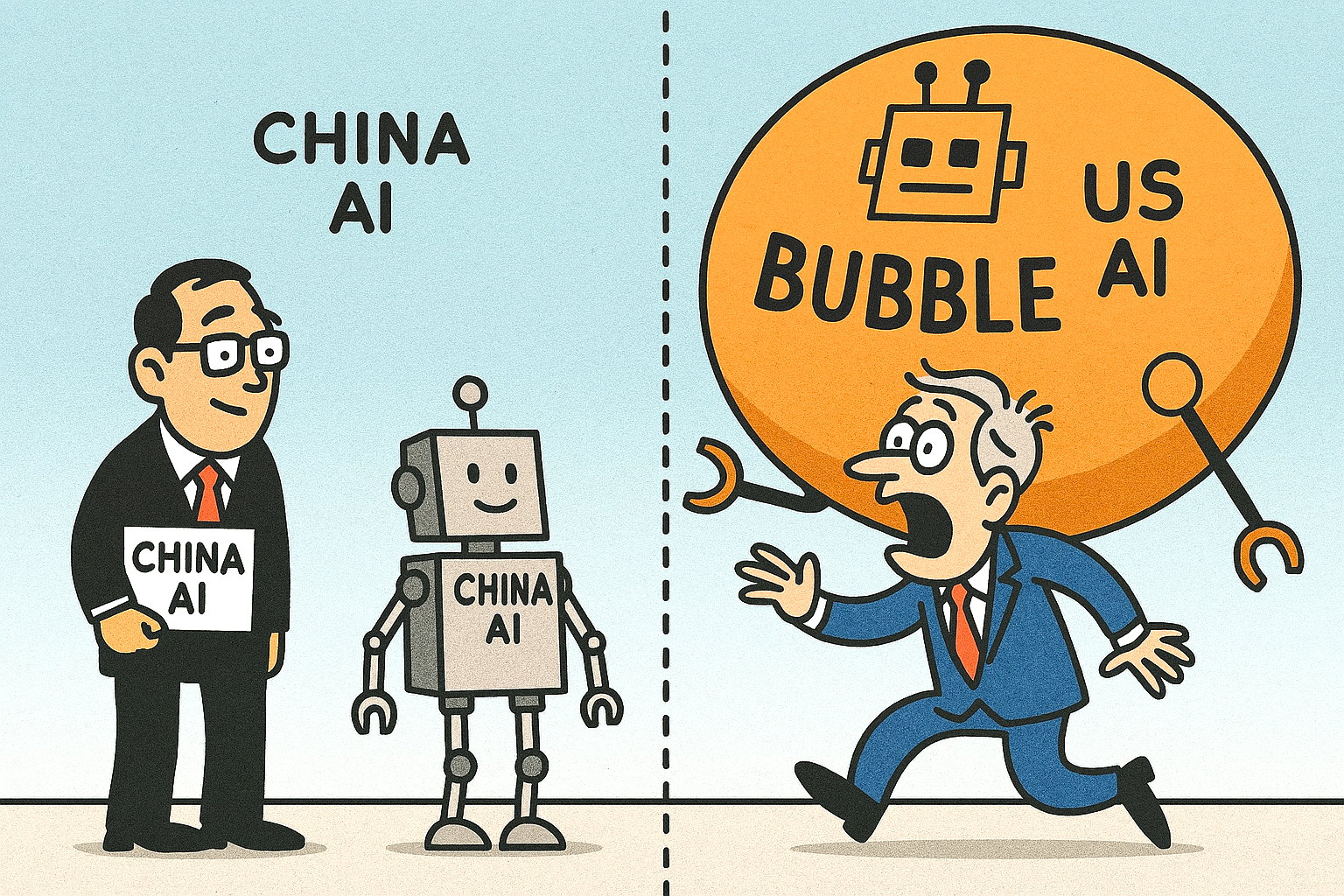
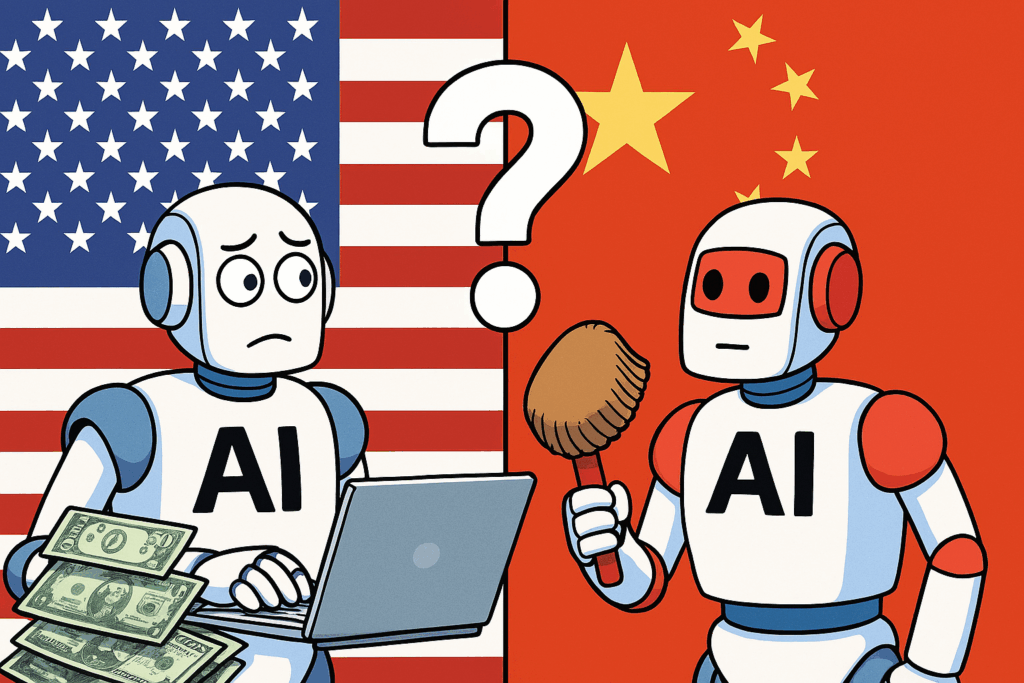
China’s AI industry has indeed cultivated a reputation for ‘doing more with less’, while the U.S. has poured vast sums into AI development, raising concerns about overinvestment and inflated valuations.

The contrast lies not only in the scale of funding but also in the efficiency and strategic focus of each country’s approach.

The U.S. Approach: Scale and Spending

The United States remains the global leader in AI infrastructure, driven by massive private investment and access to advanced computing resources.

Venture capital deals in U.S. AI and robotics startups have more than quadrupled since 2023, surpassing $160 billion in 2025.

This surge has produced headline-grabbing valuations, such as humanoid robotics firms raising billions in single rounds. Yet analysts warn of bubble risks, with valuations often detached from sustainable revenue models.

The U.S. strategy prioritises scale: building the largest models, securing the most powerful GPUs, and attracting top-tier talent.

This has led to breakthroughs in generative AI and large language models, but at extraordinary cost.

Estimates suggest that OpenAI alone has spent over $100 billion on development. Critics argue this reflects a ‘more is better’ philosophy, where innovation is equated with sheer financial muscle.

China’s Approach: Efficiency and Restraint

China, by contrast, has invested heavily but with a different emphasis. In 2025, Chinese AI investment is reportedly projected at $98 billion, far below U.S. levels.

Yet Chinese firms have achieved notable progress by focusing on cost-efficient innovation. For example, AI2 Robotics developed a model requiring less than 10% of the parameters used by Alphabet’s RT-2, demonstrating a commitment to leaner, more resource-conscious design.

Foreign investors are increasingly drawn to China’s cheaper valuations, which are roughly one-quarter of U.S. equivalents.

This efficiency stems from lower research costs, government-led initiatives, and a culture of frugality shaped by regulatory pressures and limited access to advanced hardware.

Rather than chasing scale, Chinese firms often prioritise practical applications and affordability, enabling broader adoption across industries.

Doing More with Less?

The evidence suggests that China has achieved competitive outcomes with far fewer resources, while the U.S. has arguably overpaid in pursuit of dominance.

However, the U.S. still leads in infrastructure, talent, and global influence. China’s strength lies in its ability to innovate under constraints, turning scarcity into efficiency.

Ultimately, the question is not whether one side has ‘overinvested’ or ‘underinvested’, but whether their strategies align with long-term sustainability.

The U.S. risks a bubble fuelled by excess capital, while China’s leaner approach may prove more resilient. In this sense, China is indeed ‘doing more with less’—but whether that will be enough to surpass U.S. dominance remains uncertain.

Bubble vulnerability

The sheer scale of U.S. AI investment has left the industry vulnerable to bubble shock, as valuations and spending appear increasingly detached from sustainable returns.

Analysts warn that the U.S. equity market is showing signs of an AI-driven bubble, with trillions poured into data centres, chips, and generative models at unprecedented speed.

While this has fuelled rapid innovation, it has also created irrational exuberance reminiscent of the dot-com era, where hype outpaces monetisation.

If growth expectations falter or capital tightens, the U.S. could face sharp corrections across tech stocks, credit markets, and employment, exposing the fragility of an industry built on extraordinary but potentially unsustainable levels of investment.

China’s humanoid robots are coming for Elon Musk’s Tesla $1 trillion dollar payday

China humanoid robot challenge

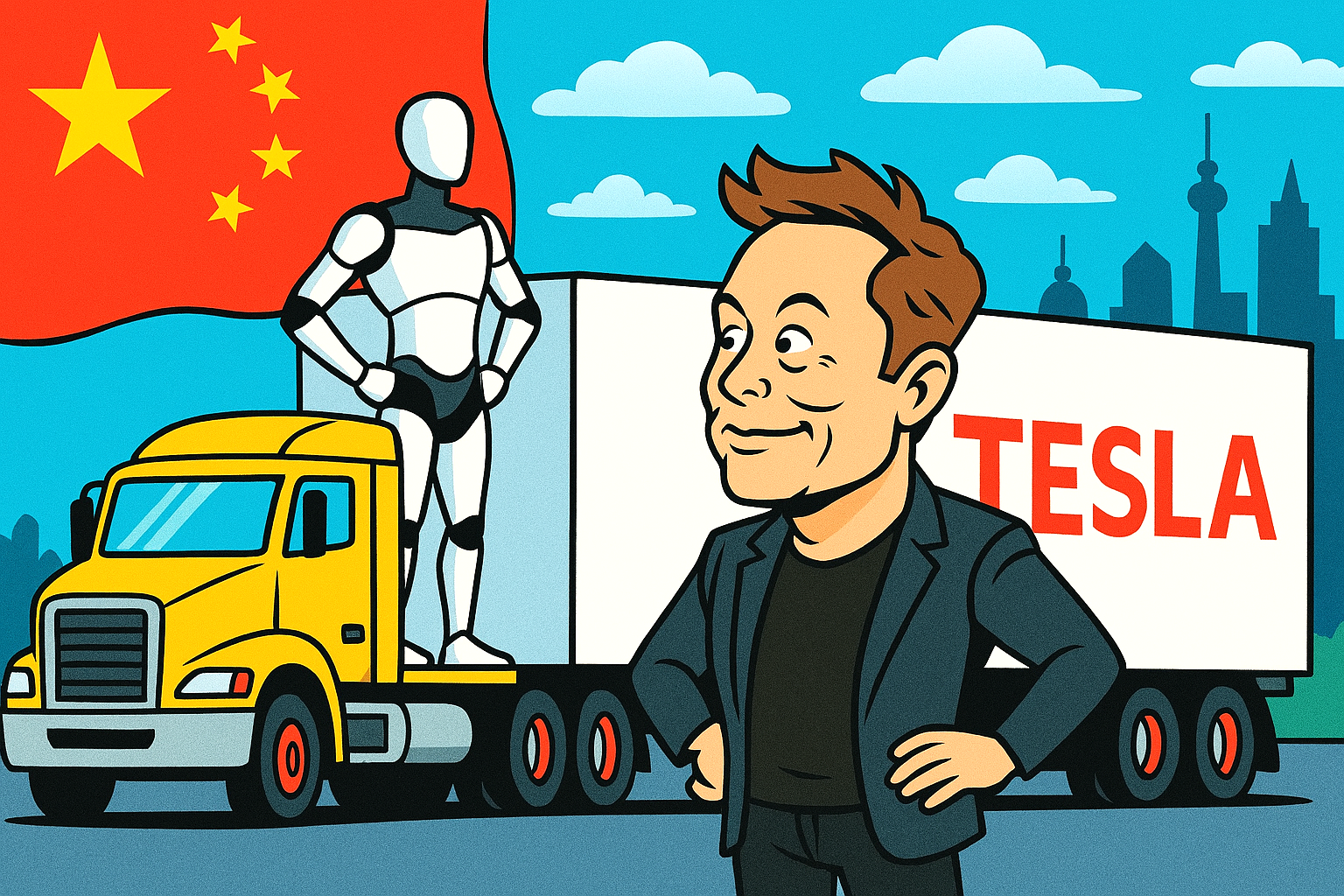
Elon Musk’s $1 trillion Tesla payday is tightly bound to the rise of humanoid robots—and China’s role in their production may determine whether his vision succeeds.

Elon Musk’s record-breaking compensation package, worth up to $1 trillion, hinges on Tesla’s transformation from an electric vehicle pioneer into a robotics powerhouse.

At the centre of this ambition is Optimus, Tesla’s humanoid robot, designed to walk, learn, and mimic human actions. Musk envisions deploying one million robots within the next decade, a scale that would redefine both Tesla’s business model and the global labour market.

Yet the road to mass production likely runs directly through China. While Tesla engineers designed prototype Optimus in the United States, China dominates the industrial infrastructure and critical components needed for large-scale deployment.

Robot installations in China

In 2023 alone, China reportedly installed over 290,000 industrial robots, more than the rest of the world combined, and reached a robot density of 470 per 10,000 workers, surpassing Japan and Germany.

This aggressive expansion is reportedly backed by state subsidies, low-cost financing, and mandates requiring provincial governments to integrate automation into their restructuring plans.

For Musk, this creates both opportunity and risk. On one hand, China’s manufacturing ecosystem offers the scale and efficiency necessary to bring Optimus to market at competitive costs.

On the other, Beijing’s strict regulations on humanoid robots introduce uncertainty, with geopolitical permission becoming the most unpredictable factor in Tesla’s robot revolution.

If Musk can navigate these challenges, Optimus could anchor Tesla’s evolution into a robotics giant, securing the milestones required for his trillion-dollar payday, and beyond.

But if Chinese competitors or regulatory hurdles slow progress, Tesla risks losing ground in the very sector Musk believes will make work ‘optional’ and money ‘irrelevant’.

In short, the robots coming from China are not just machines—they are very much the ‘key code’ to Musk’s trillion-dollar future.

Never underestimate Elon Musk.

Tesla’s $1 Trillion Bet on Elon Musk

$1 trillion Elon pay deal

In a move that has stunned financial analysts, corporate governance experts, and the broader public alike, Tesla Inc. has approved a record-breaking $1 trillion (£761 billion) compensation package for its CEO, Elon Musk.

In a landmark decision, Tesla shareholders have approved a staggering $1 trillion (£761 billion) compensation package for CEO Elon Musk, marking the largest executive pay deal in corporate history.

The vote, held at Tesla’s annual meeting in Austin, Texas, reportedly saw over 75% of investors back the plan, reaffirming their confidence in Musk’s leadership and long-term vision.

Share deal

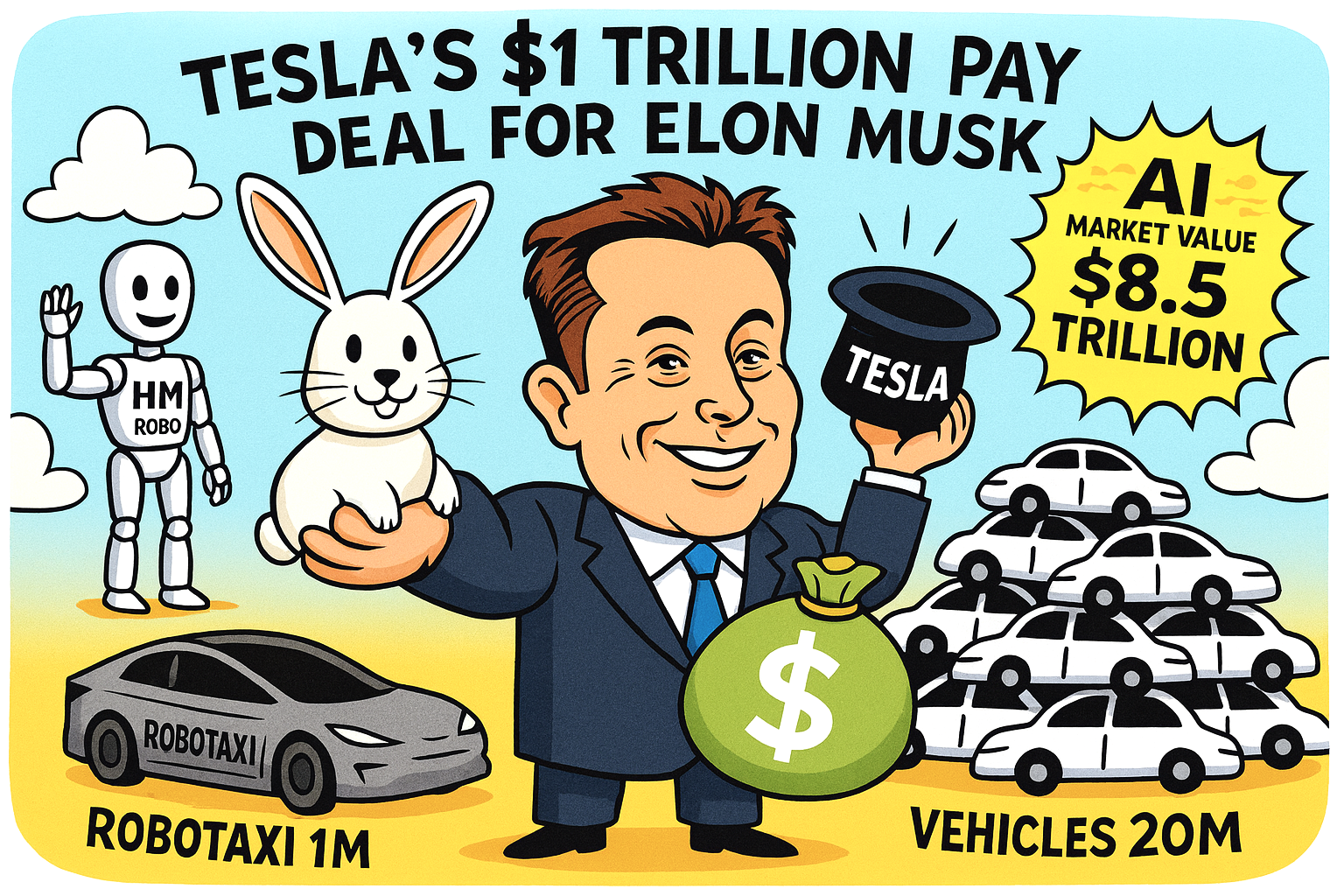
The deal is entirely performance-based, with Musk eligible to receive up to 423 million Tesla shares if the company meets a series of ambitious milestones.

These include producing 20 million vehicles annually, deploying one million robotaxis and humanoid robots, and reaching a market valuation of $8.5 trillion.

Reportedly there is no salary or cash bonus—Musk’s payout depends solely on Tesla’s success.

Supporters argue the package aligns Musk’s incentives with shareholder interests, encouraging innovation and growth.

Critics, however, warn of governance risks and the unprecedented concentration of wealth and power.

Musk, already the world’s richest person, could become the first trillionaire if Tesla achieves its targets.

The vote signals Tesla’s intent to evolve beyond electric vehicles into a broader tech powerhouse, betting on AI, robotics, and autonomy—with Musk at the helm.

Elon Musk suggests Tesla will use humanoid robots in 2025

A humanoid robot image

Tesla boss Elon Musk says the electric car maker will start producing and using humanoid robots from next year.

In a social media update, Elon Musk stated that Tesla will initially employ the robots, with plans to commence production for sale by 2026.

He had earlier anticipated that the robot, named Optimus, would be operational in Tesla factories by this year’s end. Additionally, companies such as Honda Rototics and Boston Dynamics are also advancing their humanoid robot technologies.

“Tesla will have genuinely useful humanoid robots in low production for Tesla internal use next year and, hopefully, high production for other companies in 2026,” Mr Musk posted on his social media platform X.

What is Grok?

Robot learning

Definition

Grok is a neologism (a newly coined word or expression), referenced by Robert A. Heinlein for his 1961 science fiction novel Stranger in a Strange Land. It means to understand something so deeply that you become one with it.

Grok is a term used in computer programming to mean to ‘profoundly understand something‘, such as a system, a language, or an algorithm.

Elon Musk’s Grok

Elon Musk debuts ‘Grok’ AI bot to rival ChatGPT and others. But, ‘Grok’ isn’t quite ready yet for the general public – it still has some learning to do. xAI, Elon Musk’s new AI venture, launched its first AI chatbot technology named ‘Grok’.

The prototype is in its infancy and early stages of training and is only available to a select group of users before a wider release.

Elon Musk debuts ‘Grok’ AI bot to rival ChatGPT and others. But, ‘Grok’ isn’t quite ready yet for the general public – it still has some learning to do

Musk is positioning xAI to compete with OpenAI, Inflection, Anthropic and others.

Less woke

Grok, the company said, is modelled on ‘The Hitchhiker’s Guide to the Galaxy’. It is supposed to have ‘a bit of wit, a rebellious streak’ and it should answer the ‘spicy questions’ that other AI might dodge, according to a statement from xAI.

Grok, the company said, is modelled on ‘The Hitchhiker’s Guide to the Galaxy’.

The company’s published mandate is to build artificial intelligence ‘to advance our collective understanding of the universe’. Musk has previously said that he believes today’s AI makers are bending too far toward ‘politically correct’ systems.

xAI’s mission, it reportedly said, ‘is to create AI for people of all backgrounds and political views’.

Future AI

Self-driving car technology, an AI Chatbot built around humour with access to current public data through X, a robot called Optimus and Musk’s drive for the ‘different’. If you add all this together, X.ai, through Musk, is likely positioning itself for the next big push in AI…

A humanoid robot for the workplace and for the home! Get ready… it’s coming!

Robots are coming to a home near you..?

Robot AI

Think of the biggest market for a physical product you can possibly imagine – are you thinking mobile phones, cars or game devices even? Think again…?

They are all big commercial markets but in the coming decades a new product is coming and it will be so desirable that it will dwarf these giants – it will be… the ‘robot’.

Robots will be able to understand what we want, comprehend the way the world works and looks and have the skills to execute our commands in a safe and controlled manner – at home and in the workplace.

Biggest market

The labour market is the biggest market that has ever existed in the history of business – it’s the market where we want things ‘done’ – where we do things – and it’s forever evolving. It carries massive stock market and investing potential right now and for the future.

Robot AI tech
Robot AI tech – a market place to explore

Take Nvidia, Microsoft, Google, Meta, Apple and Tesla as prime examples of companies pioneering technological advancements for instance – we can already enjoy and invest in these – and there’s much more to come.

Dozens of firms around the world are working on the technology

In the UK, Dyson is investing in AI and robotics aimed at household chores.

One of the highest profile companies in the market is Tesla, Elon Musk’s electric car company. It is working on the Optimus humanoid robot, which Mr Musk intimates could be on sale to the public in a few years’ time.

Massive tecnological advancement in artificial intelligence (AI) and robotics suggest the development of humanoid robots is accelerating… and fast. It’s a race to the become the first to succeed in the biggest practical labour market ever… and it carries huge potential for everyone, including you and me.

20 years from now…? Where were Tesla and Apple 20 years ago?

Twenty years at the pace the technology is developing now is is an eternity – every week, month and year there are new developments in the AI world that have introduced fundamental changes and enhancements to our world.

Mainstream interest in AI exploded late 2022 when a powerful version of ChatGPT was made public. Its ability to generate almost unlimited useful text and images has spawned rivals and a wave of investment in AI technology.

But developing the AI that would allow a robot to complete useful tasks is a different and much more difficult task. Tesla could be the company best placed to be one of the first to achieve this goal – given its advancements in ‘self driving’ technology. But, unlike ChatGPT and its rivals, humanoid robots have to navigate the physical world and need to understand how objects in that world relate to each other.

Tasks that seem easy to humans are major feats for humanoid robots. This is a problem that engages a lot of different complex issues in an AI driven robotics system. Picking up a cup and having a drink is a major undergoing for a robot.

The market place potential is unlimited

The potential market for robots in the future depends on various factors, such as the level of technological innovation, the demand from different industries and sectors, the regulatory and ethical frameworks, and the social and economic impacts of robot adoption. But if recent developments are anything to go by – it promises to be big!

Robot
Robot AI – a massive potential future market place

Based on the some indicative web search results, the current market size for robots is estimated to be around $55 billion to $114 billion in 2023, depending on the type and scope of robots included. The projected market size for robots in 2028 or 2029 ranges from $165 billion to $260 billion, with a compound annual growth rate (CAGR) of 11.4% to 17.6%.

The professional services robots, which include medical, agricultural, and personal assistance robots, are expected to dominate the market and account for more than half of the total sales by 2030. The industrial and logistics robots, which include conventional, collaborative, and mobile robots, are also expected to grow steadily and increase their productivity and efficiency in various manufacturing and transportation applications.

However, these projections are based on assumptions – but one thing is for sure the robots are coming and the market will be massive!

I for one will be keeping a watchful eye on where to invest my hard earned cash to take advantage of this potentially high growth market in the coming years (and now).

Nvidia stock anyone?