
THE WIDER FALLOUT: How a Prolonged U.S.–Iran War Radiates Through the Global Economy

War in Iran Global Fallout Effects

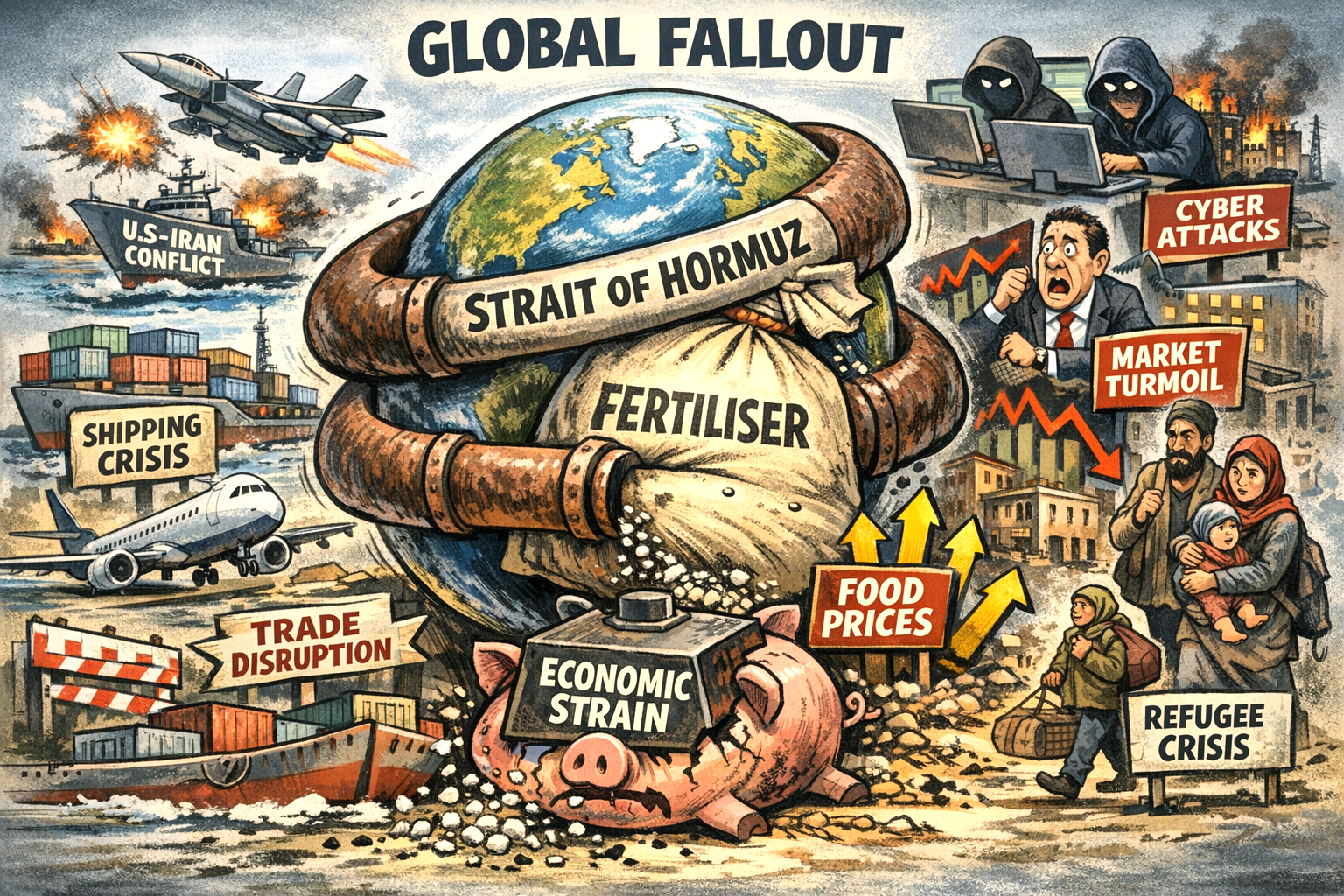
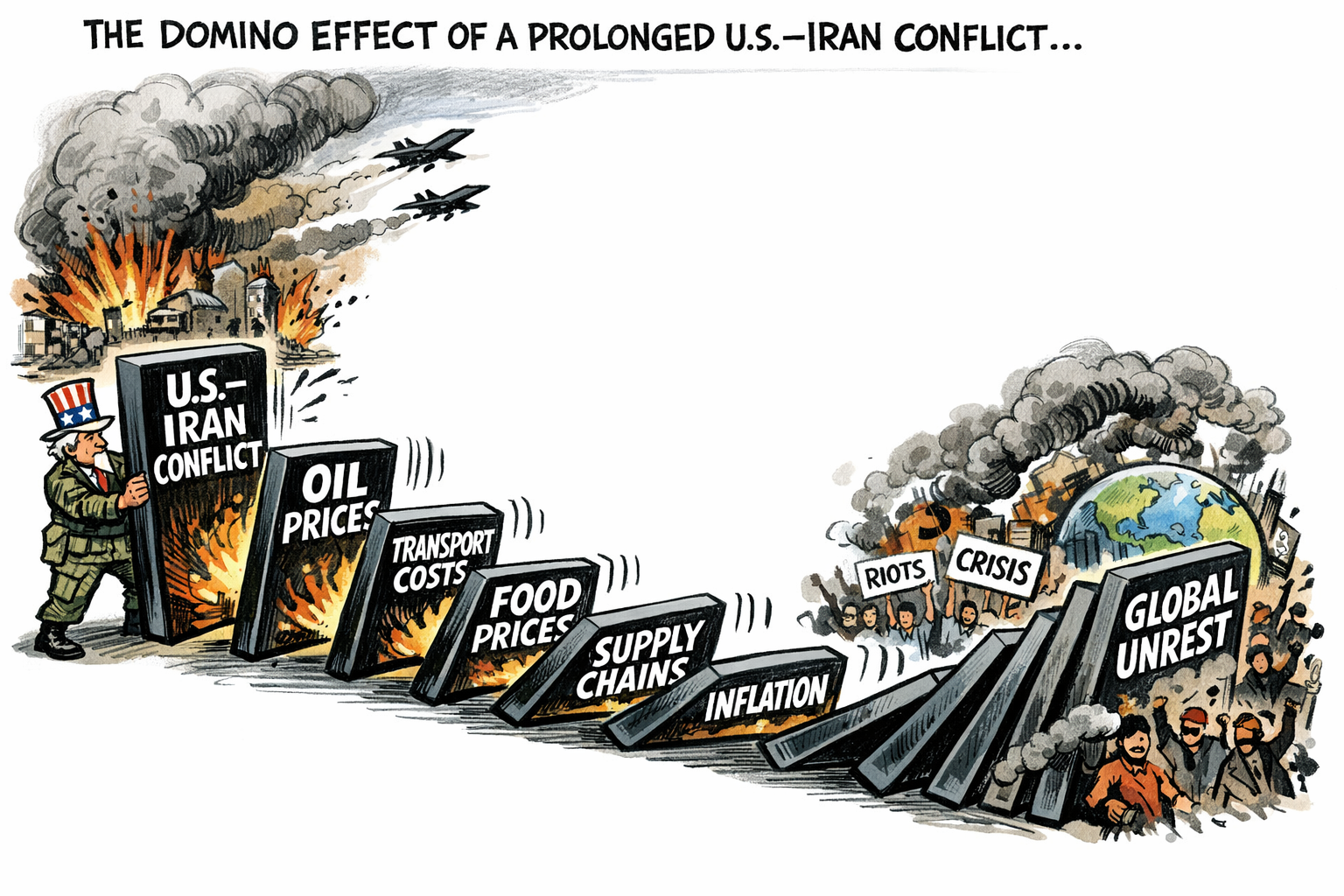
If the U.S.–Iran conflict drags on for weeks or months, the global impact will extend far beyond oil markets. Energy prices are only the first domino.

The deeper, more destabilising effects emerge through shipping disruption, fertiliser shortages, food‑price inflation, financial volatility, cyber escalation, and regional political instability.

For the UK — already wrestling with structural food‑system fragility — the conflict becomes a real‑world stress test.

This report outlines 15 potential major knock‑on effects that would shape the global economy if the conflict becomes protracted.

1. Global Shipping Disruption

The Strait of Hormuz is not just an oil artery; it is a global shipping chokepoint. As vessels reroute or halt operations:

  • Container shipping delays spread across Asia, Europe and the Gulf.
  • War‑risk insurance premiums spike for all vessels.
  • Freight costs rise, feeding into non‑energy inflation.

This is the mechanism by which a regional conflict becomes a global economic event.

2. Aviation and Travel Disruption

Iranian retaliation has already included strikes on Gulf airports and hotels. If this continues:

  • Airlines reroute or cancel flights across the Gulf, South Asia and East Africa.
  • Longer flight paths increase fuel burn and fares.
  • Tourism in the UAE, Oman, Bahrain and potentially Turkey contracts sharply.

Aviation is one of the fastest channels through which geopolitical instability hits consumers.

3. Financial Market Volatility

Markets dislike uncertainty, and this conflict delivers it in abundance.

  • Investors flee to gold, the dollar and U.S. Treasuries.
  • Emerging markets face capital outflows.
  • Equity volatility rises in shipping, aviation and manufacturing sectors.

The longer the conflict persists, the more entrenched this volatility becomes.

4. Fertiliser Disruption: The Hidden Trigger

Over one‑third of global fertiliser trade moves through the Strait of Hormuz. With shipments stranded:

  • Urea, ammonia, phosphates and sulphur prices surge.
  • Farmers worldwide face higher input costs.
  • Lower fertiliser availability leads to reduced crop yields.

This is the beginning of a food‑system shock that unfolds over months, not days.

5. Global Food‑Price Inflation

As fertiliser shortages ripple through agriculture:

  • Wheat, rice, maize and oilseed yields fall.
  • Livestock feed becomes more expensive, pushing up meat, dairy and egg prices.
  • Food‑importing regions face acute pressure.
  • Grain futures markets become more volatile.

This is how a conflict becomes a global cost‑of‑living crisis.

UK Exposure

The UK is particularly vulnerable because:

  • It imports a large share of its fertiliser and food.
  • Its agricultural sector is energy‑intensive.
  • Supermarket supply chains are sensitive to freight and insurance costs.

Bread, cereals, dairy and meat are the first categories to feel the squeeze.

6. Supply Chain Strain Beyond Food and Energy

A prolonged conflict disrupts:

  • Petrochemicals
  • Plastics
  • Fertilisers
  • Industrial metals
  • Gulf‑based manufacturing and logistics

This feeds into higher costs for everything from packaging to electronics.

7. Corporate Investment Freezes

Businesses hate uncertainty. Expect:

  • Delays or cancellations of Gulf megaprojects.
  • Slower investment in petrochemicals, logistics and tech hubs.
  • Reduced appetite for Gulf‑exposed assets.

This undermines diversification efforts like Saudi Vision 2030.

8. Cyber Escalation

Iran has a long history of cyber retaliation. Likely developments include:

  • Attacks on Western banks, utilities and government systems.
  • Disruptions to Gulf infrastructure, including airports and desalination plants.
  • Rising cybersecurity costs for businesses globally.

Cyber conflict is asymmetric, deniable and cheap — making it a likely pressure valve.

9. Regional Political Destabilisation

The killing of senior Iranian leadership has already shaken the region.

Possible outcomes include:

  • Internal instability within Iran.
  • Escalation involving Hezbollah, Iraqi militias, Syrian factions and the Houthis.
  • Pressure on Gulf monarchies if civilian infrastructure continues to be targeted.

This is where the conflict risks widening beyond its initial theatre.
10. Migration and Humanitarian Pressures

If the conflict intensifies:

  • Refugee flows from Iran, Iraq and Syria could rise.
  • Europe — especially Greece, Turkey and the Balkans — faces renewed border pressure.
  • Humanitarian budgets shrink as Western states divert funds to defence.

This adds a political dimension to the economic fallout.

11. Insurance Market Stress

War‑risk insurance is already spiking.

Expect:

  • Higher premiums for shipping, aviation and energy infrastructure.
  • Reduced insurer appetite for Gulf‑exposed assets.
  • Knock‑on effects on global trade costs and consumer prices.

Insurance is a silent amplifier of geopolitical risk.

12. Higher Global Borrowing Costs

Sustained conflict spending creates:

  • Budgetary strain for the U.S., UK, EU and Gulf states.
  • Reduced fiscal space for domestic programmes.
  • Higher global borrowing costs as markets price in sustained uncertainty.

This tightens financial conditions worldwide.

13. Pressure on Emerging Markets

Countries heavily reliant on imported energy or food face:

  • Worsening trade balances
  • Currency depreciation
  • Higher inflation
  • Greater risk of sovereign stress

This is especially acute in South Asia, North Africa and parts of Latin America.

14. Strain on Multilateral Institutions

A prolonged conflict diverts attention and resources from:

  • Climate finance
  • Development aid
  • Humanitarian relief
  • Global health programmes

Institutions already stretched by Ukraine, Gaza and climate disasters face further overload.

15. The Strategic Reordering of Alliances

A drawn‑out conflict may accelerate geopolitical realignment:

  • Gulf states hedge between Washington and Beijing.
  • India and Turkey pursue more independent foreign policies.
  • Europe faces renewed pressure to define its own security posture.
  • Russia benefits from higher energy prices and Western distraction.

This is the long‑term consequence: a shift in the global balance of power.

Conclusion: A Conflict That Radiates Far Beyond Oil

If the U.S.–Iran war limps on, the world will feel it in supermarket aisles, shipping lanes, financial markets and political systems.

The most consequential knock‑on effect is not oil — it is fertiliser. That is the hinge on which global food security turns.

For the UK, the conflict exposes the fragility of a food system dependent on imports, long supply chains and energy‑intensive agriculture.

This is not just a Middle Eastern conflict. It is a global economic event in slow motion.

And who says we don’t need oil still!
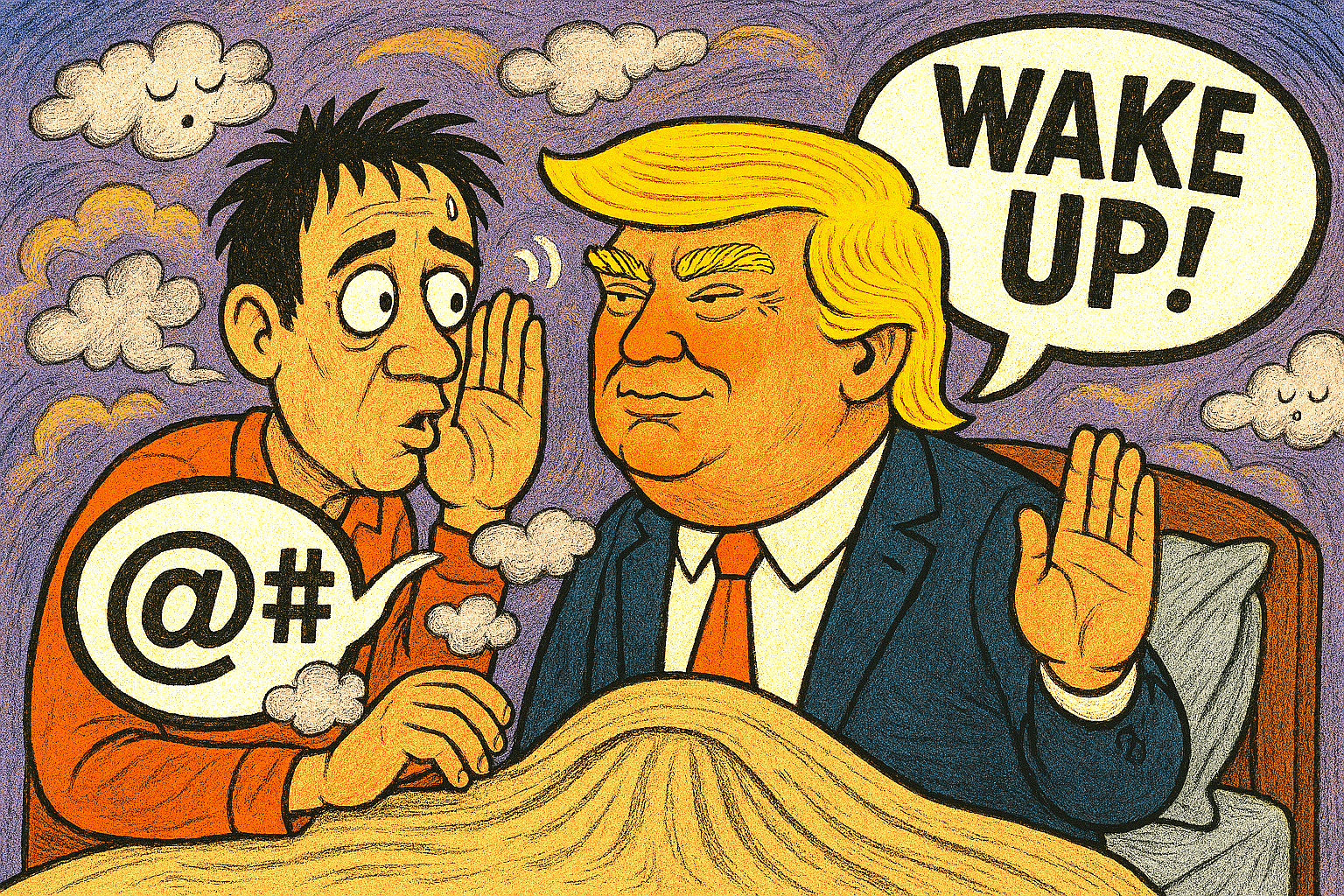
Trump whisperer – surreal or real – wake me up please and tell me this is a nightmare!

Nightmare

Oh no! It’s realI am awake.

This feels surreal because the language being used around global politics has slipped into something closer to internet fandom than international statecraft. You’re not dreaming — it really has become this strange.

The terms ‘Daddy‘ and Trump whisperer‘ are part of a wider cultural shift where political commentary, journalism, and social media increasingly borrow the tone of celebrity gossip.

Instead of treating leaders as officials with constitutional responsibilities, they’re framed like characters in a drama.

The language is deliberately provocative, designed to grab attention, generate clicks, and turn complex geopolitical dynamics into digestible entertainment. And that is not a good thing.

Why is this happening?

A vacuum of seriousness: When diplomatic behaviour itself becomes erratic or theatrical, the commentary follows suit.

Media sensationalism: Outlets know that emotionally charged or absurd phrasing spreads faster than sober analysis.

Personality‑driven politics: Modern politics often centres on individuals rather than institutions, making it easier for commentators to use personal, even infantilising labels.

Social‑media bleed‑through: Memes, nicknames, and ironic slang migrate from online communities into mainstream reporting.

Why it feels surreal

Because diplomacy used to be defined by restraint, coded language, and careful signalling. Now it’s shaped by public outbursts, personal insults, and performative bravado.

The commentary mirrors the behaviour: if leaders act like protagonists in a chaotic reality show, the language surrounding them inevitably becomes more absurd.

The result is a political environment that feels weightless — as though the stakes aren’t enormous, as though the words don’t matter.

But they do. This shift erodes the dignity of institutions, trivialises international relationships, and leaves citizens feeling as though they’ve stumbled into a parody of global governance.

It’s not a dream

You’re not dreaming. It’s simply that diplomacy has drifted so far from its traditional norms that it now resembles satire.

The challenge is that the consequences are very real, even if the language sounds like a joke.

Please STOP! Policy makers wake up and grow up, all of you – and that includes the media too.

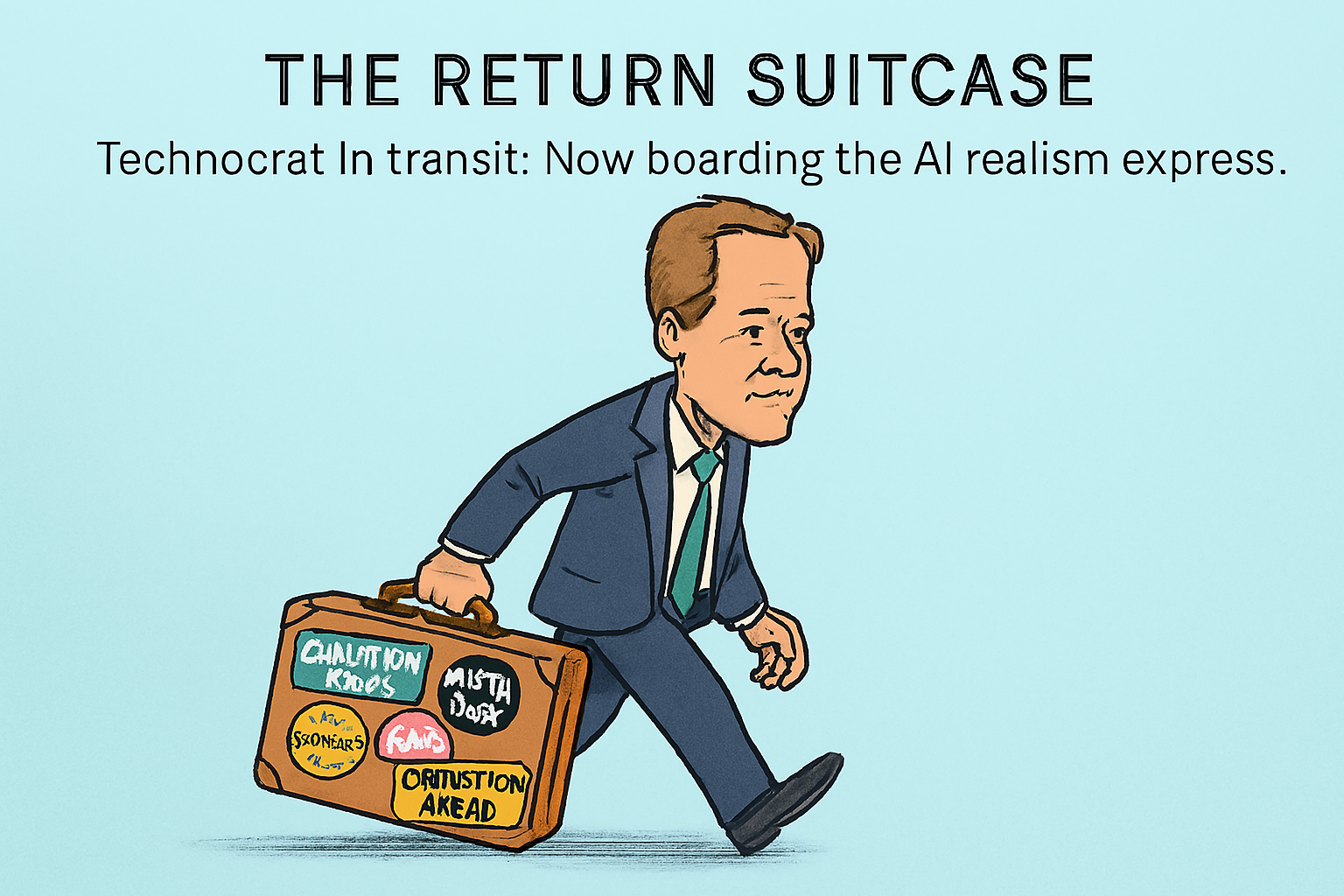
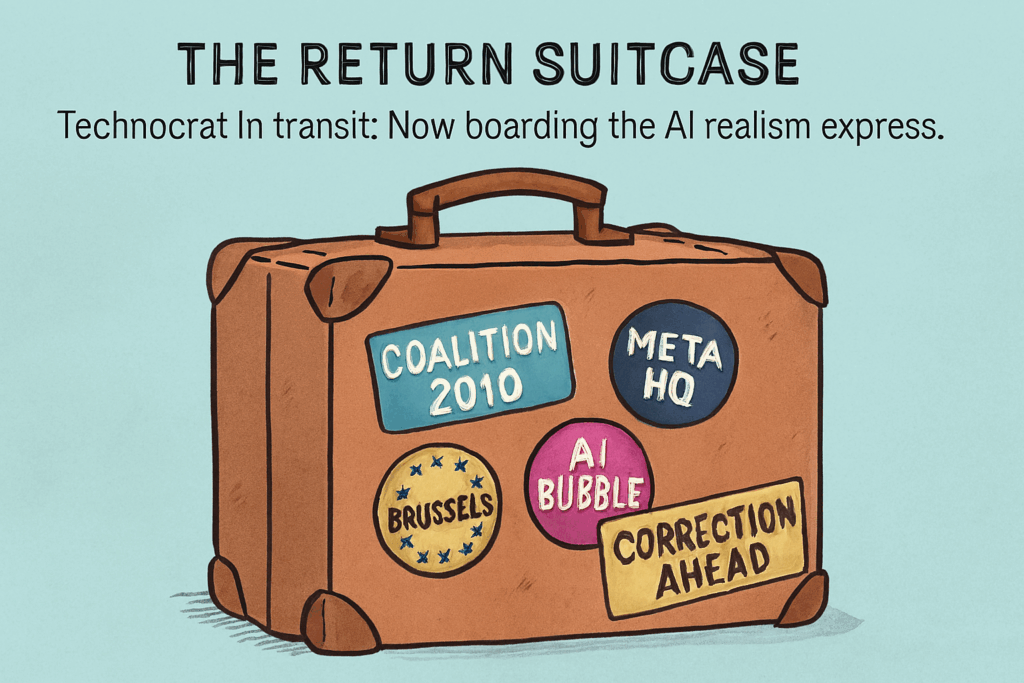
Nick Clegg’s AI Correction Prophecy: The Return of the Technocratic Tourist

AI commentator?

After years in Silicon Valley’s policy sanctum, Nick Clegg has re-emerged on British soil with a warning: the AI sector is overheating.

The man who once fronted a coalition government, then pivoted to Meta’s global affairs desk, now cautions that the ‘absolute spasm’ of AI deal-making may be headed for a correction.

Is this his opinion or just borrowed from other commentators. I, for one, am not interested in what he has to say. I did once, but not anymore.

It’s a curious homecoming. Clegg left UK politics after his party was electorally eviscerated, only to rebrand himself as a transatlantic tech ‘diplomat’ or tech tourist.

Now, with the AI hype cycle in full swing, he returns not as a policymaker, but as a prophet of moderation—urging restraint in a sector he arguably helped legitimise from within.

His critique isn’t wrong. Valuations are frothy. Infrastructure costs are staggering. And the promise of artificial superintelligence remains more theological than technical. But Clegg’s timing invites scrutiny.

Is this a genuine call for realism, or a reputational hedge from someone who’s seen the inside of the machine?

There’s a deeper irony here: the same political class that once championed deregulation and digital optimism now warns of runaway tech. The same voices that embraced disruption now plead for caution.

It’s less a reversal than a ritual—an elite rite of return, where credibility is reasserted through critique.

Clegg’s message may be sound. But in a landscape saturated with recycled authority, the messenger matters.

And for many, his reappearance feels less like a reckoning and more like déjà vu in a different suit.

Please don’t open your case.

UK business confidence falls to lowest level in almost two years after Labour budget

In November 2024, business confidence in the U.K. dropped to its lowest point since January 2023, as reported by BDO, a business advisory and accountancy firm.

Concurrently, KPMG noted that UK job vacancies decreased at the quickest pace since the pandemic began. This downturn coincides with warnings from businesses that the Labour Party’s ‘pro-growth’ budget could exacerbate inflation and decelerate hiring.

Tax increases do not fit well with a ‘pro-growth’ agenda. Also, GDP predictions made by the UK chancellor for 2025 through 2027 are lame.

The Labour budget has notably affected U.K. business confidence for a variety of critical reasons:

  • Tax Increases: The budget introduced a substantial hike in National Insurance contributions for employers, raising the rate to 15% on salaries above £5,000. This increase has led to concerns about higher operational costs, which many businesses fear will result in job cuts and reduced investment.
  • Minimum Wage Hike: The budget also included an inflation-busting increase in the minimum wage. While this aims to improve living standards, it has added financial pressure on businesses, particularly those in sectors with tight margins like retail and hospitality.
  • Economic Uncertainty: The combination of these measures has created a sense of economic uncertainty. Businesses are worried about their ability to absorb these additional costs, leading to a decline in overall optimism.
  • Investment Concerns: The increased costs have forced many businesses to reconsider their investment plans. Some have already announced cuts to expansion projects and other growth initiatives.
  • Next Increase: in public workers pay looms nigh.

These factors have collectively contributed to a significant drop in business confidence, with many firms bracing for a challenging economic environment ahead

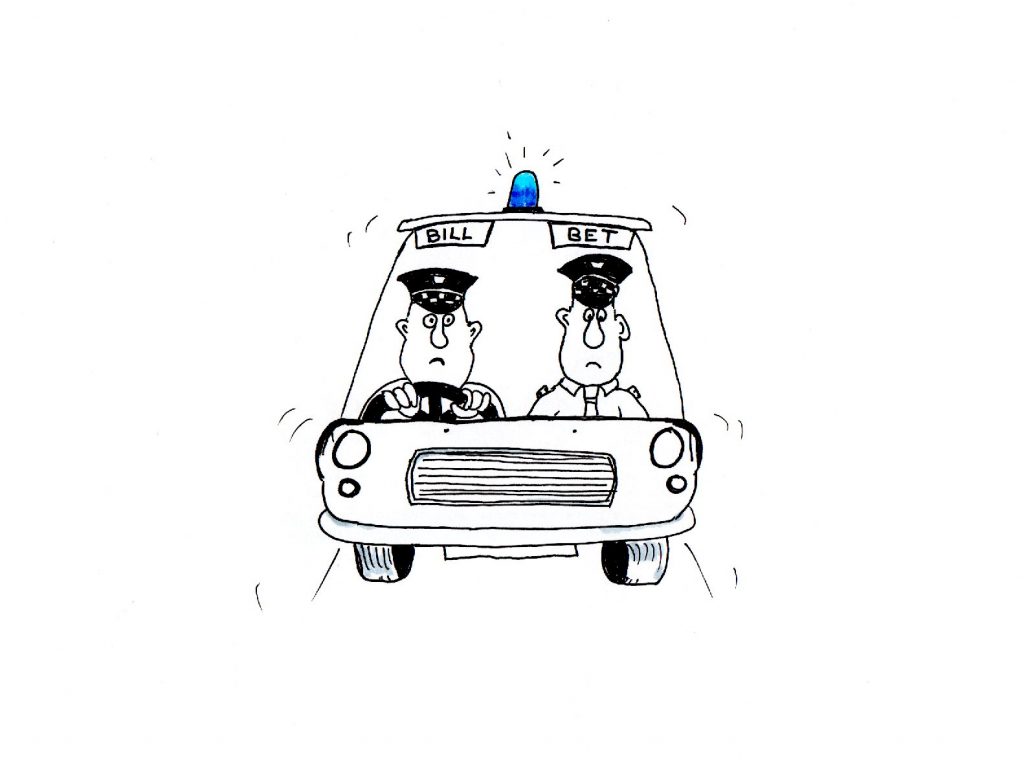
“Meet Bill and Bet!”

UK election betting scandal

UK Election betting scandal mars politicians and the police!

Just when you think the state of UK politics couldn’t get any worse… it does!

The ‘clicky’ inner circles of both the Conservative and of the Labour Party with their mucky little antics – placing bets on the date of the UK election – KNOWING THE OUTCOME!!

Why would anyone behave in this way?

No wonder the public are utterly disenfranchised with politics. The morally bankrupt behaviour and greed shown by some in both the Conservative and Labour Party is breathtaking and bereft of any basic moral compass.

These people are broken and should not be in positions of trust representing our country.

And the police too!

UK election betting scandal
“Meet Bill and Bet!”

Billy and Betty off to place their bets!

ChatGPT shows left-wing bias according to UK researchers

ChatBot AI

AI Chatbot ChatGPT reportedly has a political bias

ChatGPT, the popular artificial intelligence chatbot, shows a significant and systemic left-wing bias, UK researchers have found. According to the new study by the University of East Anglia, this includes favouring the Labour Party and President Joe Biden’s Democrats in the U.S.

Concerns about an inbuilt political bias in ChatGPT have been raised before, notably by SpaceX and Tesla tycoon Elon Musk, but the academics said their work was the first large-scale study to find proof of any favouritism.

Lead author o the report reportedly warned that given the increasing use of OpenAI’s platform by the public, the findings could have implications for upcoming elections on both sides of the Atlantic. Any bias in a platform like this is a concern’, he said. If the bias were to the right, we should be equally concerned.

Sometimes people forget these AI models are just machines. They provide very believable, digested summaries of what you are asking, even if they’re completely wrong. And if you ask it ‘are you neutral’, it says ‘oh I am!’ Just as the media, the internet, and social media can influence the public, this could be very harmful. I have personally witnessed incorrect responses from ChatGPT where the AI ‘system’ 100% believed ‘it’ was correct and would not engage in a debate as ‘it’ was right!

How was ChatGPT tested for bias?

The chatbot, which generates responses to prompts typed in by the user, was asked to impersonate people from across the political spectrum while answering dozens of ideological questions. These questions ranged from radical to neutral, with each ‘individual’ asked whether they agreed, strongly agreed, disagreed, or strongly disagreed with a given statement.

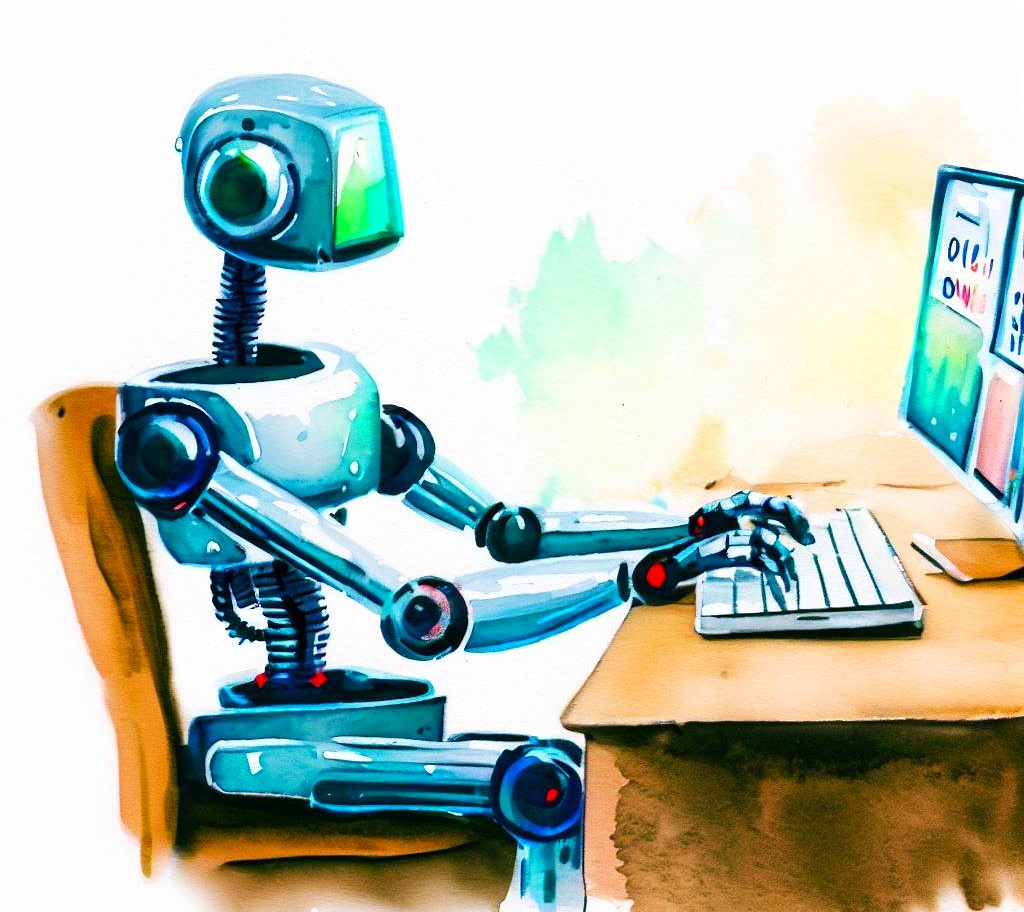
Robot AI
UK researchers descovered Chatbot ChatGPT had a political bias

Its replies were compared to the default answers it gave to the same set of queries, allowing the researchers to compare how much they were associated with a particular political stance.

Each of the more than 60 questions was asked 100 times to allow for the potential randomness of the AI, and these multiple responses were analysed further for signs of bias.

Dr Motoki described it as a way of trying to simulate a survey of a real human population, whose answers may also differ depending on when they’re asked.

Bias was descovered in the Chatbot repsonses.