


The Coming Crunch: Could AI Face a Global Memory Shortage?

Looming AI memory shortage

The rapid acceleration of artificial intelligence has created an unexpected bottleneck that few outside the semiconductor world saw coming.

A potential shortage of the high‑bandwidth memory (HBM) that modern AI systems depend upon has become a real issue.

As models grow larger and more capable, their appetite for memory grows even faster. The result is a looming constraint that could shape the pace, cost, and direction of AI development over the next five to ten years.

The issue

At the centre of the issue is the simple fact that AI models are no longer limited by compute alone. Training and running advanced systems require vast quantities of specialised memory capable of moving data at extraordinary speeds.

Only a handful of manufacturers produce HBM, and scaling production is slow, expensive, and technically demanding.

Even with aggressive investment, supply cannot instantly match the explosive demand driven by AI labs, cloud providers, and data centres.

The growing number of companies building on these models is only adding to the concerns.

If shortages intensify, the effects could ripple widely. Training costs may rise as competition for memory pushes prices higher.

Smaller companies could find themselves priced out of cutting‑edge development, deepening the divide between the largest AI players and everyone else. Hardware roadmaps might slow, forcing engineers to prioritise efficiency over sheer scale.

AI deceleration?

In the most constrained scenarios, progress in frontier AI could decelerate simply because the physical components required to build it are unavailable.

Is this crisis inevitable? Not necessarily. The semiconductor industry has a long history of overcoming supply constraints through innovation, investment, and new fabrication techniques.

Alternative memory architectures, improved model‑compression methods, and more efficient training strategies are already being explored.

Yet the demand curve remains steep, and the next few years will test whether supply chains can keep pace with AI’s ambitions.

A genuine memory crunch is not guaranteed, but it is plausible enough that the industry is treating it seriously.

If nothing else, it highlights a truth often forgotten in the excitement created around new technological developments, in this case… AI.

Even the most advanced intelligence still relies on very real, very finite physical infrastructure.

Arm taking its place in the AI race

AI chip stock up

Arm’s strong growth forecast has led investors to declare it an AI darling

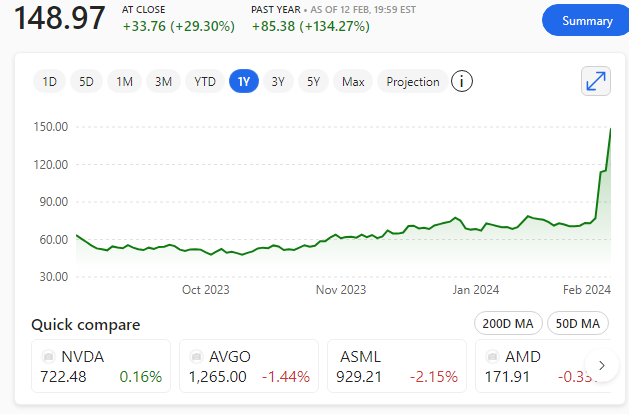
Arm shares soared 29% on Monday, extending last week’s rally as investors continue to applaud the chipmaker’s better-than-expected third-quarter earnings and its position in the artificial intelligence boom.

Up 93% since 8th February 2024

Arm is now up 93% since it reported quarterly figures on 8th February 2024. There is no obvious reason for the 29% climb on Monday. The fear of missing out (FOMO) could be playing a part in the meteoric share price move.

The stock has almost tripled since Arm’s initial public offering in September 2023, closing at $148.97 and is now worth almost $153 billion, that’s a little more than $30 billion below Intel’s market cap.

Arm 1 year chart showing huge gain in February 2024

Arm 1 year chart showing huge gain in February 2024

AI demand fuels Arm’s success

Last week, Arm said it could double the price for its latest instruction set, which accounts for 15% of the company’s royalties, suggesting it can expand its margin and make more money off new chips. It also said it was breaking into new markets, such as cloud servers and automotive, due to AI demand.

Its royalty strength combined with Arm’s optimistic growth forecast has made the company the latest AI darling among investors, despite a higher earnings multiple than Nvidia or AMD.

What China’s new stance in microchip battle means

Gallium and Germanium

Gallium and germanium

No, nor me – never heard of them, but they are extremely important elements needed in microchip manufacturing and China is the world’s largest producer.

Germanium and gallium are two elements that are used in the production of semiconductor chips, which are essential for various electronic devices and technologies. They have different properties and applications, and they are both considered critical materials.

Germanium

Germanium is a metalloid, which means it has properties of both metals and non-metals. It is a shiny, hard, gray-white element that is brittle and can be cut easily with a knife. It has a high melting point of 938°C and a low boiling point of 2830°C. It is mainly obtained as a by-product of zinc production, but it can also be extracted from coal.

Germanium is used in, solar cells, fibre optic cables, infrared lenses light-emitting diodes (LEDs), and transistors. It is also used in some alloys to improve their strength and hardness. Germanium is essential for the defence and renewable energy sectors, as well as for space technologies. It can resist cosmic radiation better than silicon, and it can enhance the performance and efficiency of some semiconductors.

Gallium

Gallium is a metal that has a very low melting point of 29.8°C, which means it can melt in your hand. It is a soft, silvery-white element that can be easily cut with a knife. It has a high boiling point of 2403°C.  It is mainly obtained as a by-product of processing bauxite and zinc ores.

Gallium and Germanium considered critical elements required in the production of microchips

Gallium is used in the electronics industry to produce heat-resistant semiconductor wafers that can operate at higher frequencies than silicon-based ones. It is also used in LEDs, solar panels, microwave devices, sensors, and lasers. Gallium is important for the development of new technologies such as electric vehicles, high-end radio communications, and Blu-Ray players. It can also improve the power consumption and reliability of some semiconductors.

China the largest producer

China is the largest producer and exporter of both germanium and gallium, accounting for about 60% and 80% of the global supply. However, China has recently announced new export restrictions on these two elements, requiring special licences for exporters. This move is seen as a response to the western sanctions on China’s access to advanced microchip technology. 

The export curbs could affect the global supply chain of semiconductor chips and have implications for various industries and markets