

Alibaba Steps Into ‘Physical AI’ With New Robotics Model

AI robotics model

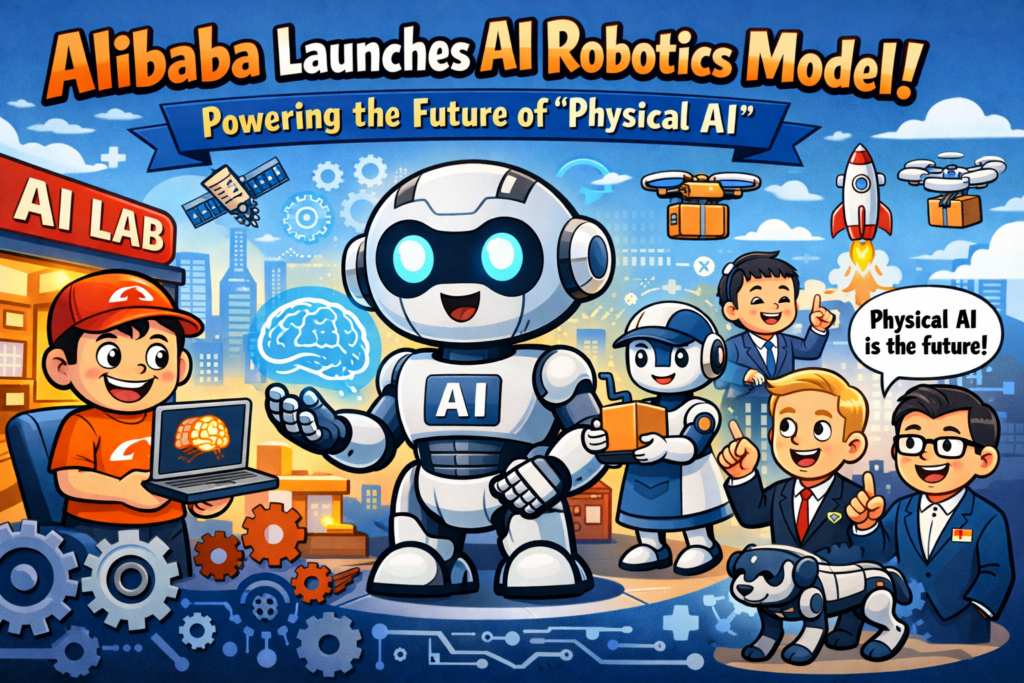
China’s Alibaba has taken a decisive step into the fast‑emerging field of ‘physical AI’ with the launch of a new foundation model designed specifically to power real‑world robots.

The model, known as RynnBrain*, marks one of the company’s most ambitious moves since restructuring its cloud and research divisions, and signals China’s intention to compete directly with the United States in embodied artificial intelligence.

Unlike traditional large language models, which operate entirely in digital environments, RynnBrain is built to interpret and act within the physical world.

It combines vision, language and spatial reasoning, enabling robots to recognise objects, understand their surroundings and plan multi‑step actions.

DAMO Acadamy

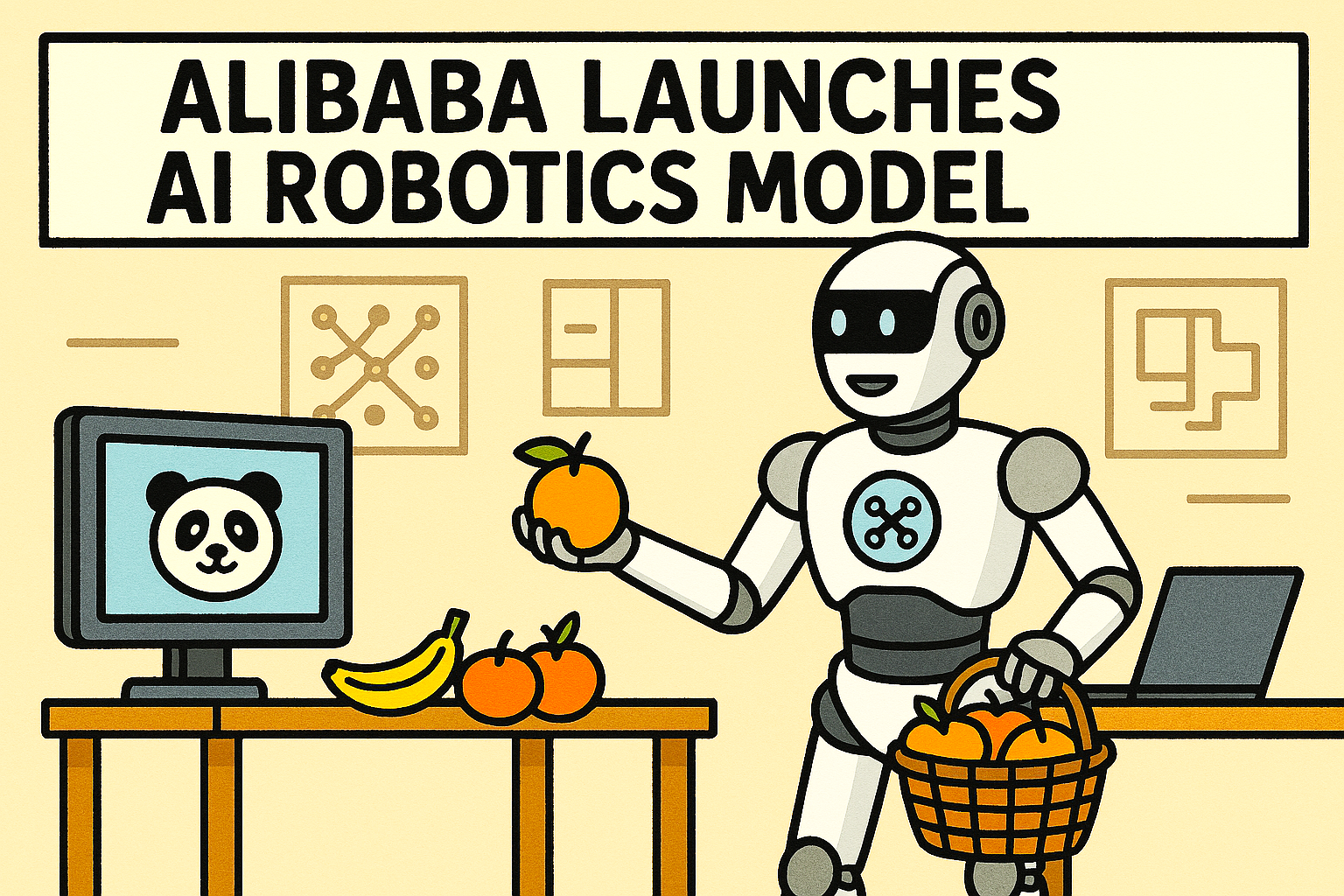
In demonstrations released by Alibaba’s DAMO Academy, the model guided a robot through tasks such as identifying fruit and sorting it into containers — a deceptively simple exercise that requires sophisticated perception and motor control.

The company describes RynnBrain as a ‘general‑purpose embodied intelligence model’, capable of supporting a wide range of robotic applications, from warehouse automation to domestic assistance.

Crucially, Alibaba has opted to open‑source the model, a strategic decision that invites global developers to build on its capabilities and accelerates the creation of a broader ecosystem around Chinese robotics research.

Physical AI

The timing is significant. Over the past year, major technology firms including Google, Nvidia and OpenAI have begun to emphasise physical AI as the next frontier of artificial intelligence.

The shift reflects a growing belief that the most transformative applications of AI will not be confined to screens, but will instead involve machines that can navigate, manipulate and collaborate within human environments.

Alibaba’s entry adds competitive pressure to a field already heating up. While U.S. companies currently dominate embodied AI research, China has made robotics a national priority, viewing it as a strategic industry with implications for manufacturing, logistics and economic resilience.

RynnBrain

By releasing RynnBrain openly, Alibaba positions itself as both a contributor to global research and a catalyst for domestic innovation.

The launch also highlights a broader trend: the convergence of AI models with physical systems. As robots become more capable and more affordable, the line between software intelligence and mechanical action is beginning to blur.

RynnBrain is an early example of this shift — a model designed not just to understand language or images, but to translate that understanding into purposeful action.

Whether Alibaba’s approach will reshape the global robotics landscape remains to be seen, but the message is clear: the race to build the brains of future machines is accelerating, and China intends to be at the forefront.

Other Major Players in Physical AI

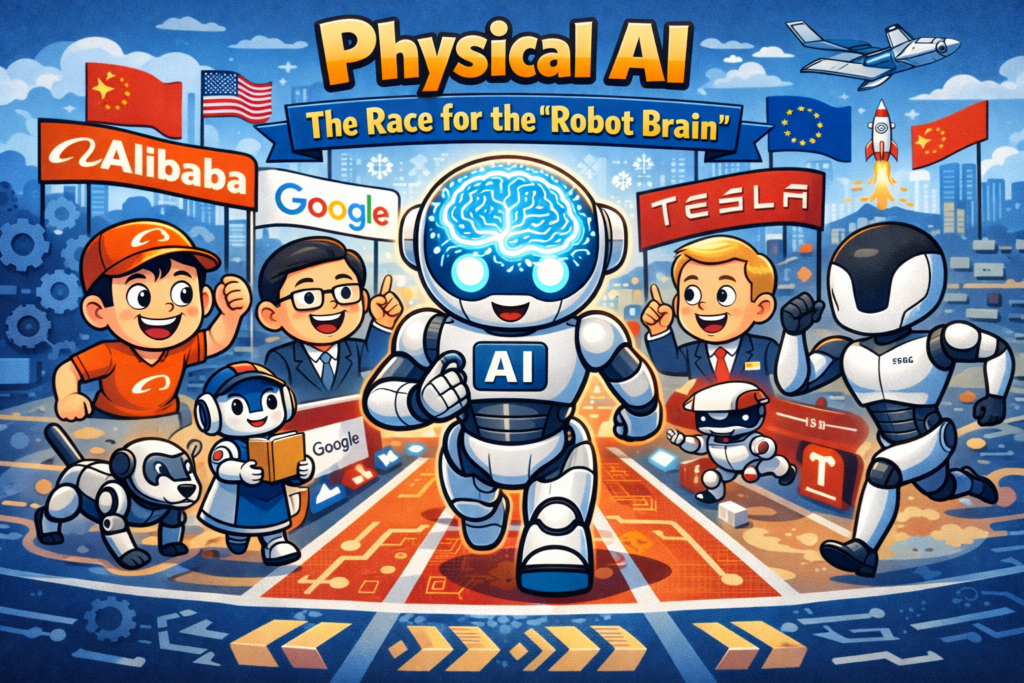
Physical AI — AI that can perceive, reason and act in the real world — has become the next strategic battleground for global tech giants. Alibaba is far from alone.

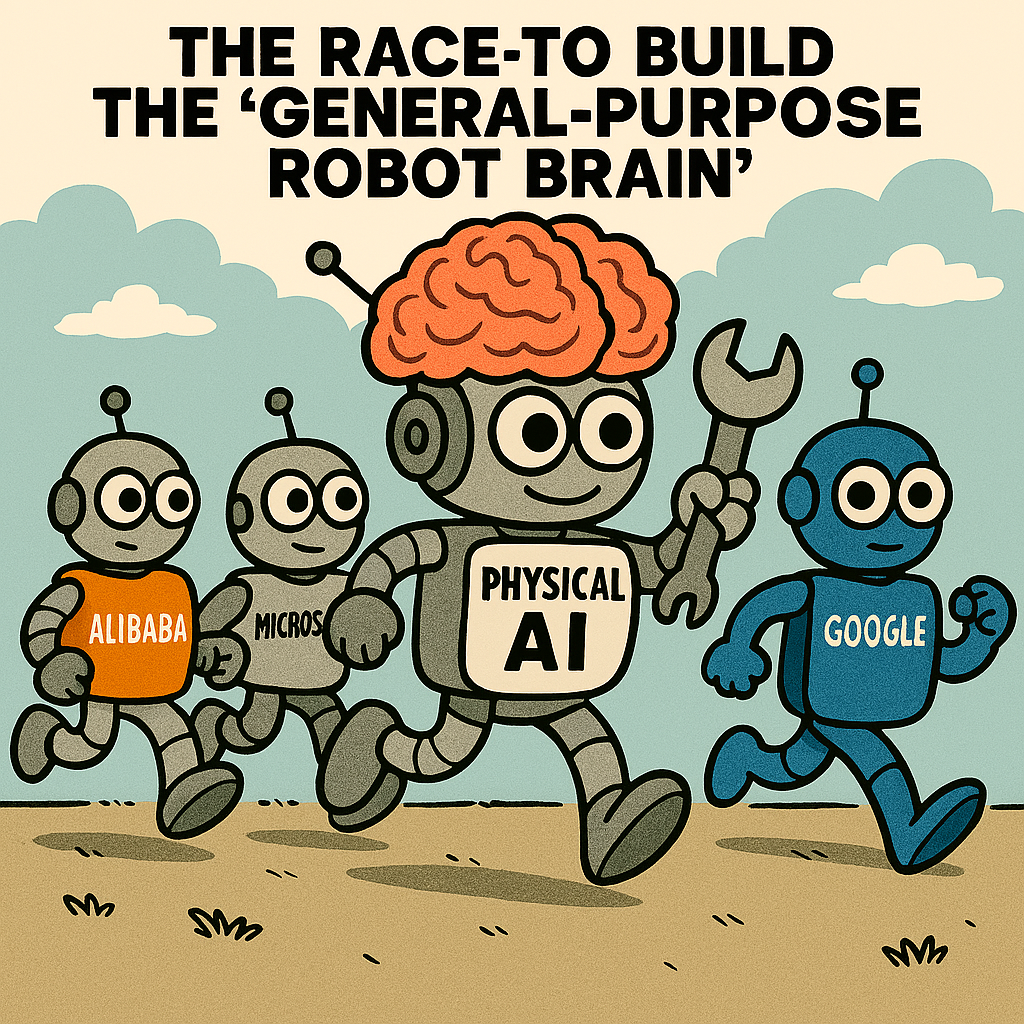
Several companies are racing to build the ‘general‑purpose robot brain’.

Below are the most significant players.

1. Google DeepMind

Focus: Embodied AI, robotics‑ready multimodal model’s Key systems:

RT‑2 (Robotic Transformer)

Gemini‑based robotics extensions

Google has been working on robotics for over a decade. RT‑2 was one of the first models to show that a language model could directly control a robot arm, interpret objects, and perform multi‑step tasks.

DeepMind is now integrating robotics capabilities into the Gemini family.

2. OpenAI

Focus: General‑purpose embodied intelligence Key systems:

OpenAI Robotics (revived internally)

Vision‑language‑action research

OpenAI paused robotics in 2020 but has quietly restarted the programme. Their models are being trained to understand video, track objects and perform physical tasks. They are also working with hardware partners to test embodied versions of their models.

3. Nvidia

Focus: The infrastructure layer for physical AI Key systems:

  • Nvidia Isaac (robotics platform)
  • Cosmos models
  • Omniverse simulation

Nvidia is not building consumer robots; it is building the entire ecosystem for everyone else. Its simulation tools, training environments and robotics‑ready AI models are becoming the backbone of the industry.

4. Tesla

Focus: Humanoid robotics Key system:

  • Optimus (Tesla Bot)

Tesla is training its robot using the same AI stack as its autonomous driving system. The company claims Optimus will eventually perform factory and household tasks.

It is one of the most visible attempts to build a general‑purpose humanoid robot.

5. Amazon

Focus: Warehouse automation and domestic robotics Key systems:

  • Proteus (autonomous warehouse robot)
  • Astro (home robot)

Amazon is integrating multimodal AI into its logistics robots and experimenting with home assistants that can navigate physical spaces.

6. Figure AI

Focus: General‑purpose humanoid robots’ Key system:

  • Figure 01

Backed by OpenAI, Microsoft and Nvidia, Figure is developing a humanoid robot designed to perform everyday tasks.

Their recent demos show robots manipulating objects and responding to natural language instructions.

7. Boston Dynamics

In partnership with Google’s DeepMind Boston Dynamics is also building a ‘foundation model intelligence’ robot brain.

The Big Picture

Alibaba is entering a field dominated by U.S. companies, but the global race is wide open. Physical AI is becoming the next strategic platform — the equivalent of smartphones in the 2000s or cloud computing in the 2010s.

*RynnBrain explained

RynnBrain is Alibaba’s open‑source ‘physical AI‘ framework designed to give robots far more capable real‑world intelligence, enabling them to plan, navigate, and manipulate objects across dynamic environments such as factories and homes.

Developed by the company’s DAMO Academy, it competes directly with Google’s Gemini Robotics and Nvidia’s Cosmos‑Reason models, with Alibaba claiming stronger benchmark performance.

The system is released openly on platforms like GitHub and Hugging Face, offered in configurations from lightweight 2‑billion‑parameter models to advanced mixture‑of‑experts variants, and includes specialised versions—Plan, Nav, and CoP—targeting manipulation, navigation, and spatial reasoning respectively.

Its launch signals China’s ambition to lead global robotics and embodied AI development.

Artificial intelligence capable of matching humans at any task will be available within five ten years

AI

Artificial General Intelligence (AGI), a form of AI capable of matching or surpassing human intelligence across all tasks, is expected to emerge within the next five to ten years, according to Demis Hassabis, CEO of Google DeepMind.

Speaking recently, Hassabis highlighted the advancements in AI systems that are paving the way for AGI.

While current AI excels in specific domains, such as playing complex games like chess or Go – it still lacks the ability to generalise knowledge and adapt to real-world challenges.

But the advancements made in AI chatbots such as ChatGPT from OpenAI and DeepSeek have showcased remarkable development, and at speed too. Applying AI to work environments, science and domestic tasks is forever expanding.

Hassabis emphasised that significant research is still required to achieve AGI. The focus lies on improving AI’s understanding of context and its ability to plan and reason in dynamic environments.

Multi-agent systems, where AI entities collaborate or compete, are seen as a promising avenue for development.

These systems aim to replicate the intricate decision-making processes humans exhibit in complex scenarios.

The implications of AGI are profound, with potential applications spanning healthcare, education, and beyond.

However, its development also raises ethical and societal questions, including concerns about control, safety, and equitable access.

While the timeline remains speculative, Hassabis’s insights underscore the accelerating pace of AI innovation, bringing humanity closer to a future where machines and humans collaborate in unprecedented ways.

Or not?

A new powerful AI is coming but the techies have no clue as to what it will look like

AGI

That’s reassuring then, and they are creating it

Leaders at some of the world’s leading artificial intelligence (AI) companies are expecting a form of AI on a par with, or even exceeding human intelligence to arrive sometime in the near future. But what it will eventually look like and how it will be applied are unknown.

Artificial General Intelligence or AGI is coming soon

Leaders from OpenAI, Microsoft and Google’s DeepMind, and many other major tech companies debated the risks and opportunities presented by AI at the World Economic Forum in Davos, Switzerland in January 2024.

AI has become the talk of ‘town’ around the world through 2023, mainly due to the success of ChatGPT, OpenAI’s popular generative AI chatbot, brought to us by Microsoft. Generative AI tools, like ChatGPT, are powered large language models, algorithms trained on vast quantities of data, but are not AGI.

Executives at some of the world’s leading artificial intelligence companies see ‘artificial general intelligence,’ or AGI, a hypothesized form of AI with intelligence on a par or better than humans. This prospect is both exciting and worrying.

Concern

AI and AGI have created concern among governments, corporations and public consultation groups worldwide, owing to the risks around the lack of transparency of AI systems; social manipulation through computer algorithms; job losses due to increased automation; surveillance; and data privacy and worse… the lack of human control!

Extinction event possible

Many industry leaders in technology have warned that AI could lead to an ‘extinction-level’ event where machines become so powerful they get out of control and wipe out humanity.

A new powerful AI is coming but the techies have no clue as to what it will look like

Several prominent technology leaders, including Elon Musk and Steve Wozniak for example, have called for a pause in AI development, stating that a moratorium would be beneficial in allowing society to catch up.

Turing test

AI chatbots like ChatGPT have passed the Turing test, a test called the ‘imitation game,’ which was developed by British computer scientist Alan Turing to determine whether someone is communicating with a machine and a human. The one big area where AI is lacking is common sense.

It has been reported on many occasions, that the tech world is taking steps to ensure that the AI race doesn’t lead to a ‘Hiroshima moment.

Will AGI be created in the image of humans?

Let’s hope not.

Cathie Wood and Ark Invest company STOCK WATCH

Cathie Wood

Tech’ investor and disruptor

Cathie Wood is an American investor and the founder, CEO and CIO of ARK Invest, an investment management firm that focuses on disruptive innovationShe is known for her bullish views on Tesla, DeepMind, and many other AI companies.

DeepMind and Tesla

Cathie Wood is a fan of DeepMind, an artificial intelligence research lab acquired by Google in 2014 and founded in 2010. She reportedly says it is ‘one of the best AI companies in the world’ and that the ‘AI revolution’ will ‘change everything’.

She also says that Tesla is the ‘biggest AI opportunity in the world’ today. She believes that Tesla has a huge advantage in data collection and innovation, and that it has just started its growth potential.

Additionally, Cathie Wood has been betting on other AI stocks, such as C3.aiUiPathExact Sciences, and Upstart. She thinks these companies have strong prospects in various fields, such as cloud computing, automation, healthcare, and lending.

British-American AI DeepMind

DeepMind is a British-American artificial intelligence research lab that is a subsidiary of Google. It was founded in 2010 and acquired by Google in 2014. DeepMind is known for creating neural network models that can learn how to play video games, solve complex problems, and mimic human intelligence. Some of its famous products are AlphaGo, AlphaZero, AlphaFold, and Flamingo.

DeepMind

Mission

DeepMind’s mission is to ‘solve intelligence and use it to make the world a better place‘.  It has been involved in various fields, such as healthcare, climate change, computer systems, and board games. 

DeepMind also collaborates with Google Cloud to enhance its solutions for customers

NOTE: Always do your own research!

RESEARCH! RESEARCH! RESEARCH!